

Amidst campaigning for the United States’ 2024 presidential election, floods of endorsements for both candidates are appearing on celebrities’ social media pages.
With an overall lack of resources and true commitment to political activism despite a huge influence in the political sphere, celebrity endorsement posts make it easier for biases from those with social power to trickle into the polls.
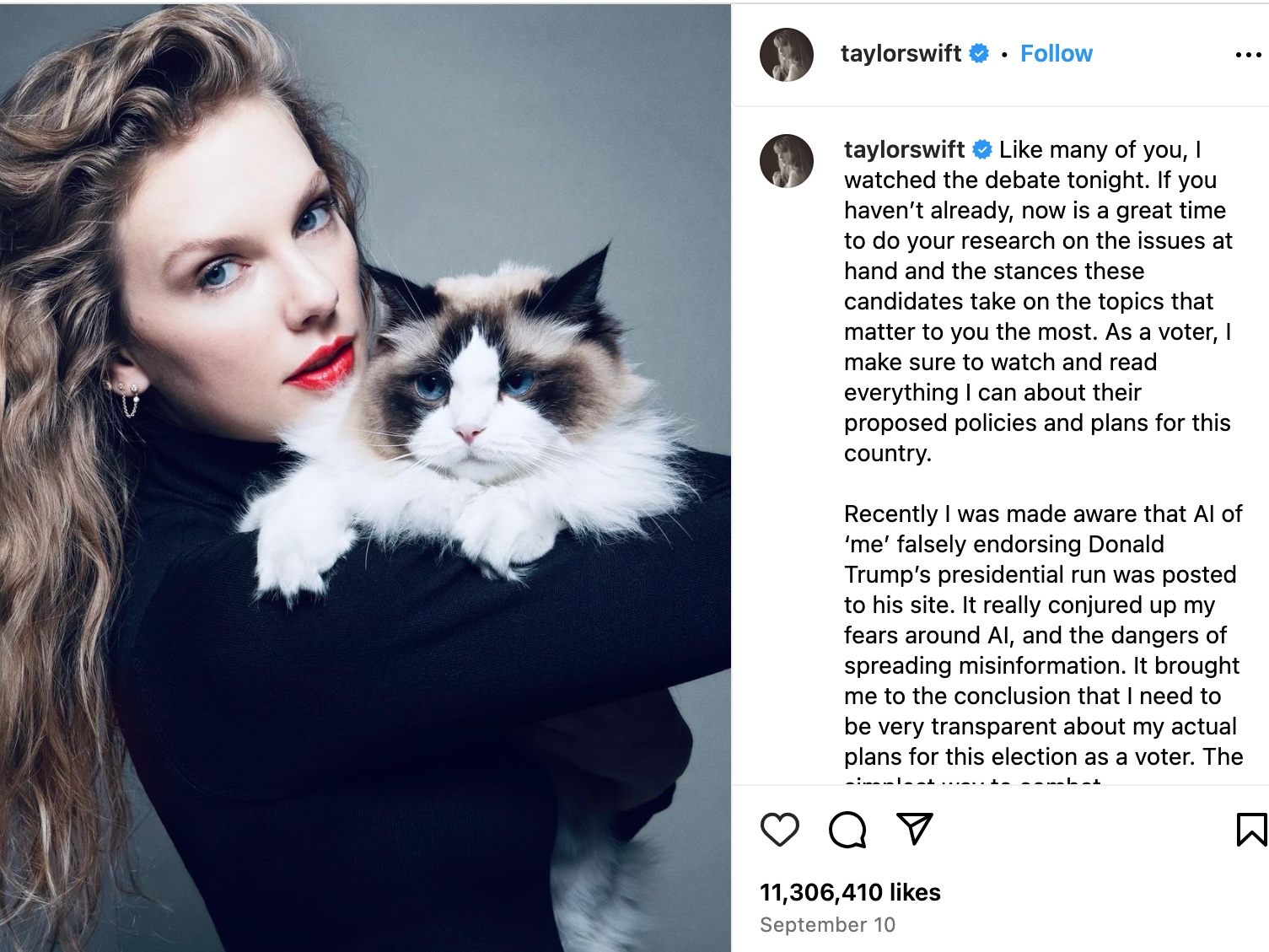
On Sept. 10, Taylor Swift made an Instagram post to her 284 million followers endorsing Vice President Kamala Harris’ presidential campaign alongside Tim Walz. In the post, Swift repeatedly urges her followers to do research and make their own conclusions about the upcoming election, though the post is absent of any resources to do so. The only resource given to fans is Swift’s clear position on the matter.
How is this any different from the posts that perpetuate blindly following uneducated public figures, the policy on which Trumpism thrives?
It’s important to preface this topic with the understanding that celebrities should use their platforms to promote activism and political awareness. The problem with this instance of endorsement — which was not only done in this manner by Swift but also by countless other celebrities on either side — is the lack of physical resources, reasoning and commitment behind their conclusions.
The latter issue is prevalent among far-right celebrities and their endorsements of presidential candidate Donald Trump. Elon Musk, for example, has taken to X to repeatedly express his endorsement of the Republican candidate. Instead of sharing political resources as reasoning for his vote, he shared several posts praising Trump and spreading misinformation to justify his stance.
Notably, Musk shared transphobic posts saying that boxer Imane Khelif was biologically male because of her elevated testosterone levels, despite the lack of evidence behind this claim, and saying that Trump will “ban biological males from competing in women’s sports.”
Musk also shared posts demonizing the Democratic Party, accusing them of eradicating democracy and saying that voting for Trump is the only way to uphold the system.
Though Swift and various other celebrities sharing endorsements have not engaged in political acts this extreme, the lack of resources to support their endorsements helps to normalize the act of casting a vote that is informed by someone else’s paraphrased research.
Notably, many of the celebrities endorsing either party running for the United States presidency rarely speak on issues surrounding politics and do not often engage in political activism. Only speaking up on politics around election time is not entirely productive and shows a lack of commitment to the subject overall.
Amidst the flood of celebrity political endorsements on social media, singer Chappell Roan shared an interesting and productive take on the matter.
In an interview with The Guardian, Roan said she refrained from sharing any political endorsements because there are “so many issues with [the United States] government in every way.” She encouraged fans to use their “critical thinking skills” and vote based on local issues.
Roan received backlash for this statement, with fans calling her “a privileged centrist.” Interestingly though, Roan has been incredibly vocal on global political issues and using her platform to educate.
Just last June, Roan declined to play at the White House for Pride, saying “we want liberty, justice and freedom for all. When you do that, that’s when I’ll come.”
Roan further explained, saying, “that means freedom in trans rights. That means freedom in women’s rights.” Roan emphasized that it “especially means freedom for all oppressed people in occupied territories.”
In a video recently shared on TikTok, Roan responded to the backlash she faced from her lack of a political endorsement. She said that her actions “have always paved the way for [her] project,” so she does not need to pick a side.
“Actions speak louder than words and actions speak louder than an endorsement,” said Roan.
Roan’s message is productive in the conversation surrounding political endorsements. If voters are not encouraged to educate themselves on political matters and come to their own conclusions on who to vote for, it makes it easier for them to fall victim to biased online messaging.
Many of the celebrities sharing endorsements do not come from political backgrounds, nor are they well-advised on global politics. They do not share political resources to back up their voting choices and to educate their followers. Yet despite all of this, they have incredible political influence.
Although Swift and other celebrities are not endorsing politicians with malicious or manipulative intent, they are strengthening the foundation for voters to get comfortable with blindly following baseless political claims online.