

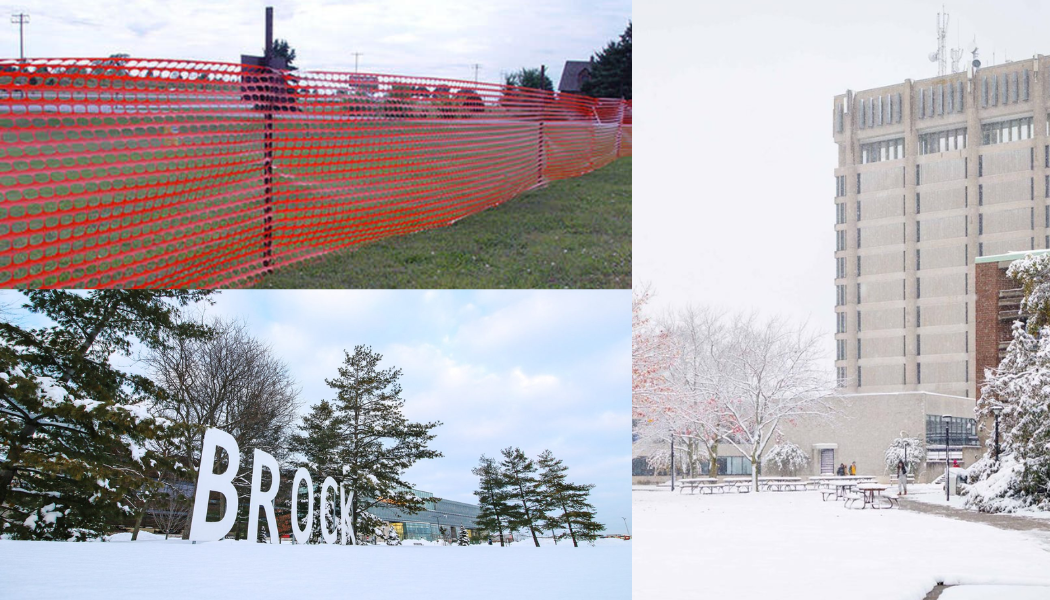
The winter months have arrived, and apart from the snow day that came a bit too early, the addition of a snowy aesthetic to campus life is an added benefit. Unfortunately, new to the daily odyssey from Lot 2 is the addition of orange fencing that borders Weather Station Field.
Apart from its unsightly appearance, the fencing appears to have been put in place in an effort to discourage students from cutting across the field along the very clear desire path.
The desire path across Weather Station Field is nothing new. In the four years that I’ve spent at Brock University, I have routinely witnessed students take this shortcut to expedite their journey from Lot 2 to anywhere that isn’t to the right of Plaza. Truth be told, of the two paved pathways from Lot 2 towards the main campus, neither is particularly efficient — especially on cold, wet and slippery days. In those conditions, the difference between a sidewalk and a field is minimal.
That’s why the choice to block off the Weather Station Field desire path is so odd. For all intents and purposes, it’s been grandfathered in for the past few years. More importantly, it’s socially accepted that students will take a shorter route because of the lack of efficient pathways from Lot 2 onto campus.
On my quests from Lot 2 to South Block or the Walker complex, I routinely cut through Lot B and D, a move that I’m sure aggravates many drivers, but is nonetheless necessary. Like many students, I don’t plan a 30-minute walk into my daily school commute.
The move to fence off Weather Station Field occurs in multiple places: both at the back where the field begins and across from Isaac’s and Union Station, where an additional paved path — that notably isn’t maintained in the winter — has also been blocked off. The fencing seems more like a choice to preserve the university’s already ruined field more than anything else.
Over the fall semester, the desire path was used more frequently than ever due to the influx of cars in Lot 2 — a problem that persists this semester. Lot 2 is fuller than ever and as a result, the desire path expanded from a simple footpath into a roughly 1.5-metre-wide strip due to foot traffic, mud and the less-than-ideal conditions of autumn. Sadly, the aesthetics of a manicured grassy knoll have been all but ruined.
If grounds maintenance installed the fencing to preserve the already damaged field, it seems they are too late, as this feels like an inopportune time to inconvenience students when nothing can be done to repair the field until warmer weather returns.
Another possibility is that the university is concerned about student safety. Grass can become slippery, and it is often subject to ice and other uncontrollable conditions. However, whether the university could be held liable for students choosing to walk on obviously risky terrain is unclear. Taking the extra step of fencing off a pathway that already has clear signage stating it is not maintained in the winter feels redundant.
Looking online, Brock University is not alone in dealing with this issue. Many universities boast large open green spaces, but it doesn’t take much searching on Reddit to see how many of those fields have been worn down by student foot traffic. For many students, getting to class on time comes before preserving the pristine green grasses that line our campus. While I would love to stop and smell the roses, I’m far more likely to step in that flower bed if it’s preventing me from getting to class on time.
One notable exception is Ohio State University, which used the desire paths created by students as a blueprint to pave efficient walkways where students actually wanted to walk.
Perhaps that’s the best choice for Brock’s ground maintenance going forward — especially as more students face longer on-foot commutes. The issue of desire paths won’t stop at Weather Station Field; other grassy corridors — including the one behind Mackenzie Chown — will be subject to the same less than ideal visual fate.
Going forward, the university should make a meaningful effort to pave and maintain new year-round walking paths for students, not simply to repair and cord off the damaged grass. This would show that student behavior and by extension student needs are being acknowledged without requiring petitions or complaints. Students would get to class faster and existing walkways would become less congested.
What’s most striking about the addition of orange fencing to Weather Station Field is that the university has recognized a problem but rather than solving it in a way that benefits both students and the institution, they have chosen to cover it up.
The fencing is unsightly and openly disapproves of student choices while ultimately doing nothing to fix the issue. Unless ground services decides to fence off the entire field, students will continue to cut across wherever there are breaks in the fencing. In that sense, the university’s attempt to stop student behavior is a fool’s errand that only draws more attention to a problem that should be meaningfully addressed.