

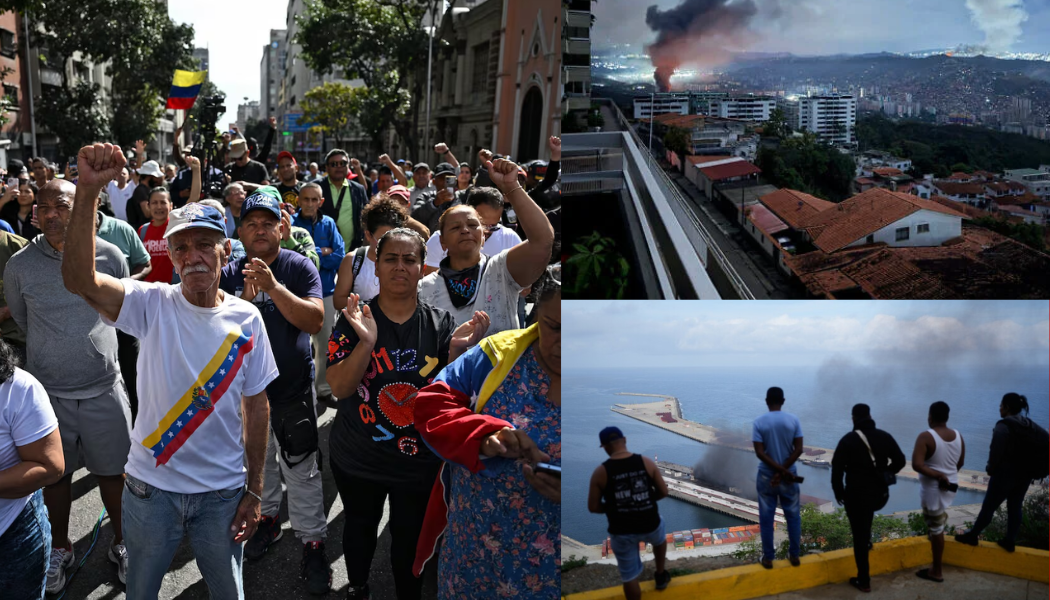
The response to the United States’ capture of former Venezuelan President Nicolás Maduro displays an unusual juxtaposition: many Americans are upset at U.S. President Donald Trump for his unannounced military intervention while, on the contrary, many Venezuelans — namely those living within the U.S. — have met the news with widespread celebration.
What’s interesting about these two responses is that, despite one being largely critical while the other is supportive, they don’t directly contradict each other. The contrast between the American and Venezuelan responses is purely a matter of perspective, and unlike the division plaguing several other political conversations of our time, these two perspectives are not mutually exclusive. In other words, there is no logical contradiction between the American perspective that Trump’s military assault is cause for concern and the Venezuelan perspective that Maduro’s removal from office is reason to celebrate.
These two arguments can logically coexist.
It should be noted that Americans and Venezuelans are each observing this case from the context of what it means (or implies) about their respective leader and their country first and foremost. Since the United States invaded Venezuela, it’s not unjust for the American people’s first thought to be about their country as the invader while Venezuelans think about it from the perspective of the invaded.
That’s not to say that Americans were happy about their government’s unannounced assault on Venezuela. Indeed, many Americans took issue with their government launching an unannounced military operation against another nation overnight.
This reaction is understandable, especially in a social landscape in which 79 per cent of the American voting population believes their nation to be in a state of political crisis. It should come as no surprise that the U.S. is in an unprecedented period of political division in which the left- and right-wings are more ideologically distant than ever before (largely attributable to the average Republican having moved further right than Democrats moving left over the last 50 years).
With that in mind, it is easy to understand why the Trump administration’s operation in Venezuela would already prove more controversial to Americans now than it would have in the 20th century. Mix in the added context of President Trump’s latest crusade in wanting to annex neighbouring landmasses like Greenland and Canada, and the negative reaction from many Americans becomes even more understandable.
In a world where the U.S. president repeatedly states his desire to annex the autonomous territory of Greenland — something only 23 per cent of Americans express support for — prompting widespread concern from longstanding allies and even causing Danish troops to be sent to Greenland’s defence just in case of an American invasion, it’s simple to grasp why the Trump administration’s invasion of Venezuela might make Americans uneasy.
Simply put, by following through on a military invasion in Venezuela, the Trump administration is putting their money where their mouth is. In his first term, President Trump had mentioned that using the American military in Venezuela was “an option.” There’s a big difference between idle threats and taking action, and Trump’s military operation in Venezuela proves his willingness to put the military to work. It’s only natural that if the American military is used in Venezuela to take Maduro out of power, Greenland — a territory that has become Trump’s new obsession — could be next.
In Trump’s 1987 book The Art of the Deal, he outlines his underlying strategy in getting opponents to make concessions: launch conversations by demanding far more than what you actually want, then negotiate your way down to what you actually want. The idea is that by the time you reach your true price, your latest request will seem reasonable in contrast to your original demand.
It wouldn’t be unreasonable to speculate, then, that Trump might not actually want all of Greenland under his thumb. If demanding complete control of Greenland and refusing to rule out military force is the first step in a long-term negotiation process meant to intimidate and threaten his European allies, it’s possible that Trump knew that annexing Greenland was impossible from the beginning, and his true aim was increasing military presence in Greenland, adding more American military bases, or something similar. Trump claims that he has started forming the “framework of a future deal with respect to Greenland” with Mark Rutte, the Secretary General of NATO — and if this is true in any capacity that does not involve a full takeover of Greenland, it’s fair to consider Trump’s negotiating tactic a success.
Yet, by following through on a military intervention in Venezuela, Trump’s administration has made this situation more complicated. This shows the American people that he is, in fact, willing to go “all the way” to get what he wants, meaning there’s cause for concern that allied territories or nations like Greenland and Canada could be next.
While Trump has since ruled out the use of military force in Greenland at the World Economic Forum, this will likely do little to quell the fears of a nation grappling with an unpredictable and temperamental leader. It’s not unusual for Trump to go back-and-forth on issues within the span of a few days, so Americans still have reason to consider the Venezuelan invasion a cause for concern.
Another problem that could be drawing the ire of Americans is Trump bypassing Congress in his Venezuelan military operation. Secretary of State Marco Rubio was quite candid about the administration not seeking Congressional approval before taking action in Venezuela, saying “it’s just not the kind of mission that you can pre-notify [Congress about] because it endangers the mission.”
But this also plays into lingering American concerns that Trump potentially bypasses the law for his own benefit or to force his agenda. It’s probably no coincidence that Venezuela has one of the world’s most potentially lucrative amounts of oil, too. When the U.S. president frequently pushes legal limits, it creates the feeling that he is above the law, and his failure to seek Congressional approval before capturing Maduro only exasperates this fear.
In case it’s not obvious, not all Americans are upset with Trump over the unannounced capture of Maduro. Some Americans are focused on what this will mean for the flow of illegal drugs into the U.S., while others are celebrating for the same reason as the Venezuelan population — something we’ll get to in a moment. And of course, there are many Americans who will always side with Trump regardless of what he does or which promises he breaks. But for the purpose of this article, I’ve chosen to focus on the majority of Americans; that is, the 56 per cent of U.S. adults who believe Trump has overstepped in military interventions abroad.
Now, let’s consider the Venezuelan perspective: one which has seen refugees and expatriates in America take to the streets in celebration (literally) over the capture of their former president. It’s a reaction defined by joy and excitement for the future, and the reason is simple:
Nicolás Maduro was an authoritarian leader who ruled over Venezuela while his people suffered, fled and died. He rigged elections to stay in power despite overwhelmingly negative reception from his population and has been accused by the United Nations of killing thousands of Venezuelans in covered-up extrajudicial murders. His time in leadership was defined by protests from hundreds of thousands of Venezuelans — a population facing extreme poverty and conditions of starvation while Maduro ruled from his ivory tower.
It’s worth noting that this celebratory response is largely occurring from Venezuelan refugees and expats living in America. Many of these people are likely political refugees. The response within Venezuela itself is significantly harder to judge. It’s naturally possible that the response within Venezuela is more aligned with the fear and uncertainty of Americans, but for the sake of this argument, we’ll focus on the reaction that we can judge.
As for that reaction, the truth is simple: any reaction from Venezuelans living outside their home country other than immediate celebration upon Maduro’s capture should have come as a surprise.
Again, remember that Americans and Venezuelans are each approaching this situation from a different perspective. Americans recognize their country as the invader and wonder what this invasion means for their place in the global political landscape; while Venezuelans come from the perspective of the invaded, prioritising what Maduro’s capture means for their families and friends.
But take note that these two perspectives do not contradict one another. Many Americans are unhappy, but not because the people of Venezuela have a chance at freedom. Many Venezuelans are happy, but not because of the implications that Trump is defying the rule of law or what he’s saying about Greenland. It is logically consistent to be simultaneously concerned about the precedent this sets for Trump’s administration and happy for the Venezuelan people who finally have their corrupt dictator out of office.
In short, the reactions to Trump’s military intervention in Venezuela may look very different on the surface, but at the core, they are logically consistent. To believe that this situation needs to be “black-and-white” reduces the opportunity to have a nuanced conversation about the positives and negatives that Nicolás Maduro’s capture will have on the greater geopolitical landscape.