

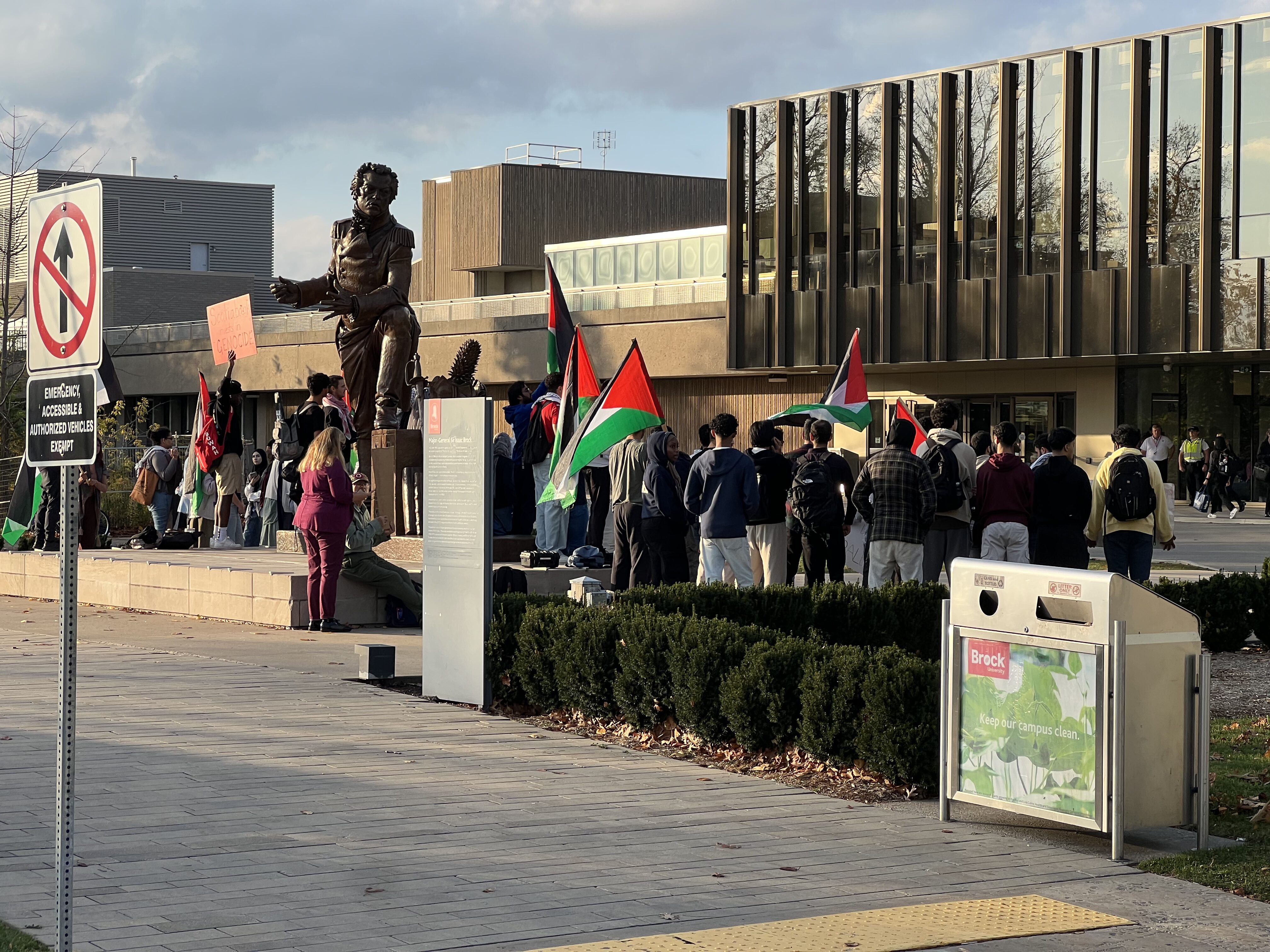
Brock University has been accused of joining a top-secret network of postsecondary institutions aimed at suppressing student demonstrations in support of Palestine on campuses across Canada.
On July 30, Breach Media published an article detailing the results of an investigation into the Canadian Post-Secondary Emergency Manager Network, an international alliance of universities and colleges that Breach alleges is intended to “surveil and suppress Charter-protected political activity on their campuses.”
Breach reporters say that they obtained information through a series of access-to-information requests, despite “delays, obstruction and even the destruction of records by university officials” who were allegedly trying to keep the network top-secret.
According to Breach, the Canadian Post-Secondary Emergency Manager Network was created in April 2024 and comprises 30 postsecondary institutions across Canada, including the University of Toronto, University of Waterloo, York University, Niagara College, Toronto Metropolitan University, McGill University and our own Brock University.
The Network’s joint SharePoint network was allegedly created by the University of Toronto on Nov. 1, 2023, with a “net widening” aimed at recruiting new members in April 2024 soon after the police response to anti-genocide protestors at Columbia University. Breach claims that the SharePoint network contained a discussion board, community guidelines, a members’ contact list, a resource library, an encampment “readiness roundup” and training opportunities.
A spreadsheet posted in the Breach article, which was allegedly posted to the Canadian Post-Secondary Emergency Manager Network, displays information on how 10 universities were preparing for encampment protests as of April 26, 2024. Brock University is among the 10 universities featured in the spreadsheet, but under the “Actions Taken” column, it shows “N/A,” suggesting that Brock may not have taken any measures against student protestors yet.
In a statement to The Brock Press, Matt Terry, Brock University’s Executive Director of Marketing and Communications, wrote that “universities are a place for dialogue and the free exchange of ideas. Brock University is deeply committed to supporting the freedom of expression, freedom of assembly and the safety and well-being of all members of our community.
“Brock does not surveil or suppress lawful student political activity. As with many universities, Brock engages with sector partners and professional networks on a wide range of issues related to campus operations, safety, risk management and student support.”
The Brock Press also spoke with David Slater, who co-authored the Breach article with Euan Thomson.
According to Slater, the Breach investigation took place over two years before the article was published in July. The investigation began when Slater and Thomson submitted access-to-information requests to various universities in Alberta before discovering links in certain documents referencing universities across the country.
According to Slater, “each university has its own sort of emergency management department or team. […] Members of these teams, individual university teams, were invited to take part in this sort-of national network that was hosted out of the University of Toronto.”
Slater said that there were “a lot of documents” that he and Thomson were unable to obtain and noted that they did not send any requests to Brock University specifically.
Slater said that the universities they did correspond with often provided conflicting statements, such as the University of Alberta, which provided them with documents, while McEwan University said the requested documents didn’t exist.
“It sort of begs the question of, where did they go?” said Slater. “This leads into questions about data retention, you know, like what are your policies? Are you following them?”
Slater said that the public response to the article has been very positive. He said that since the article’s publication in July, he has received many emails from people filing their own Freedom of Information and Protection of Privacy (FOIP) requests. Slater has heard from reporters and researchers alike, and he’s been trying to help them send these requests based on factors he learned while conducting research for the Breach investigation.
When asked why he thought that universities would conspire to suppress pro-Palestine protestors, Slater said that “there’s government interests involved, and there’s also pro-Israel lobby groups involved. So, for example, in one of the documents, there was a description of [the] Israel and Hamas war, right? And that’s right out of [the] Hasbara playbook.”
He added that “the real easy answer is that there’s an anti-Palestinian racism bias involved.”
“If pro-Israel propaganda is repeated in the media, it’s repeated in government,” said Slater. “It gets filtered into these emergency management groups.”
Slater noted that not everyone involved in the network is necessarily pro-Israel, but for some, it’s “about what types of information they’re exposed to. What is the relationship between these emergency management groups and government?”
In our interview, Slater confirmed that he and Thomson did not find anything of note regarding Brock University’s involvement in the Network beyond there being a “couple people from Brock” involved. He pointed to the spreadsheet on which Brock University lists “N/A” as their actions taken against student demonstrations as of April 2024, though he added that this was the only version of this “living spreadsheet” that he was able to access.
On his personal thoughts about the Network, Slater said that “students should know what their university is doing.”
“Students have the right to free expression. They have the right to assemble. There’s nothing inherently wrong with protesting a genocide, and any protest for that matter,” said Slater. “But if they’ll do that to these demonstrations, that means that they can do it to any demonstration, whatever the ideological cause. So that means if that ideological cause is dissenting from, say, [the] government or that university administration, then that means that this is sort of a […] suppression lever that the university can pull at any time to suppress dissent or expression.
“And ultimately, our universities should be a place for discussion, right? And if those rights are being suppressed, then they’re not rights. They’re requests.”
The Brock Press also spoke with Gökbörü Sarp Tanyildiz, an Associate Professor at Brock University who serves as the Sociology and Critical Criminology Director at Brock’s Social Justice Research Institute (SJRI). Tanyildiz, who first read the Breach article on the day it was published, expressed concerns similar to those of Slater.
Tanyildiz is deeply familiar with the difficulties that come with advocating for sensitive social causes, having been a victim of a Zionist-led harassment campaign after leading a motion at a December 2024 Brock University Faculty Association (BUFA) meeting calling for the union’s total disinvestment from organizations continuing to support Israel despite their ongoing occupation of Palestine. The motion was ultimately defeated.
During our interview, Tanyildiz expressed frustration with those who claim the university is not a political space.
“Universities are places where the values of a society are produced, contested, discussed, and therefore universities are civic institutions,” said Tanyildiz. “Everything we do has to do with politics in the university. But even beyond that, our very existence as professors, students and staff are subject to the political guidance of our society, our government. It is ruled by a mandate, and it has a lot of political will in it.”
Tanyildiz was giving lectures abroad when he read the Breach article for the first time, and he was “dismayed and shocked” by the results of the investigation, though he did not find them surprising.
“Common sense would have told us what the article [had] written,” said Tanyildiz. “In that sense, there is nothing really surprising in the article. But someone [did] that amazing work of investigative journalism, really showing us that it is not a figment of our imagination.
“In this country, universities see their students as threats,” Tanyildiz continued. “[They see] young people as suspects and want to stifle their expression.”
When asked why universities would be threatened by students, Tanyildiz said that “it is hard to occupy a mind.” He said that a university might act in secret — much like the universities that allegedly tried to keep the Canadian Post-Secondary Emergency Manager Network confidential — because if students are kept in the dark, they will not know what their university is doing wrong.
Tanyildiz said that the result of the universities’ secrecy should give all students a clear message: “that they have no say in their own education.”
“If you think of the word education as formation, we’re basically telling students that you have no right to think about, do anything, take action about your own formation. And to me, that is a very scary proposition.
“The people who are supposed to be representing universities are giving an astounding message that you are not here to be yourself. You are here to be shaped into what we want you to be.”
Tanyildiz warned students to be wary of what they assume to be normal within the university experience.
“Whatever it is [students] are being told is normal is something that has already been produced with extensive effort and resource[s],” said Tanyildiz. “And it is represented as something that is normal, should be unchallenged, should be expected… accepted and lived as the only way to learn. And I think realizing that students, whatever their political stance might be, that their lives in a university [are] subject to other people’s rules.
“Every student has an idea about what education should be like, or their existence in any space. They should also ask themselves: are my values represented by these rules that are made in secretive ways behind closed doors, with a very select representation from the [people making the decisions]?”
Tanyildiz said that people have a “horrible precedent of following orders,” and encouraged students to ask how these orders are made and who benefits from them.
When asked what message he would share with Brock University administrators if given the opportunity, Tanyildiz spoke about his larger concerns for the university in the context of Breach’s investigation.
“The authors seem to suggest that Brock University has participated in this exercise. They have been outed, which I think is a great shame for [the] Brock community. And we are all carrying that shame.
“I think the university administrators do have not only a moral responsibility, but also a professional responsibility to tell us the degree of their participation in this program, and the process in which this decision was made, what is shared, what has been shared with this greater group. […] What was shared, whose personal lives have been violated, whose data has been shared?”
Tanyildiz said that Brock must decide whether it will contribute to the making of a “just society” or instead be a hindrance. He suggested that Brock redirect its energy towards networks that prioritize transparency and openly “argue for a better university.”
When asked if he had a message for students, Tanyildiz said that he had no advice for “student demonstrators, student demonstrators [and] student thinkers,” but he did wish to extend gratitude.
“It is thanks to them that all the work that we are doing as scholars [and] researchers do find some social import, do find some context,” said Tanyildiz. “Without that real movement, without that real desire for change, everything we do would be less than