
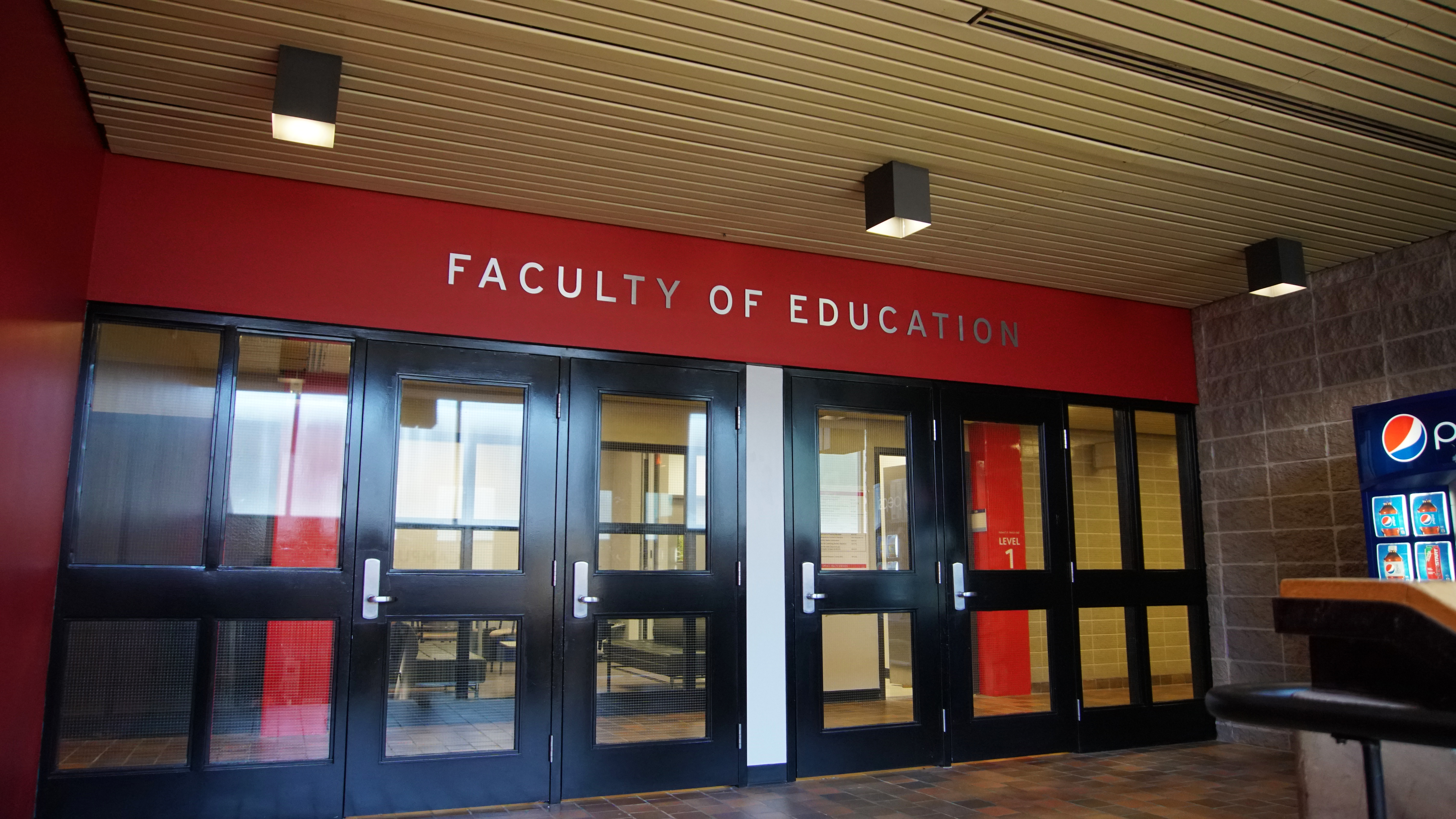
The Concurrent Education program at Brock University is unnecessarily difficult and ridiculously expensive, causing future educators to experience complete burnout before they even have a chance to reach the classroom.
Made up of one of the largest student groups on Brock University’s campus, the Concurrent Teacher Education program (Con Ed) is well known around the Niagara Region. It is one of just a few university programs in Ontario that concurrently links an undergraduate honours degree with a two-year Bachelor of Education, removing the need for stressful teacher’s college applications.
But no need to fear! The anxiety that you’re missing out on by not having to apply to teacher’s college will be made up for tenfold throughout the course of your six-year degree.
As a Concurrent Education student, I started at Brock bright-eyed and excited to be an educator. As a fifth-year student preparing for teacher’s college, I am tired and have little will left to continue. The only thing that pushes me through is my love for the profession and my dream of helping kids, something I have always wanted to do. But deep down, I know that if I continue this way, I will barely make it to my own convocation. I believe there are two huge things wrong with this program: a lack of flexibility and insane financial expectations. Let’s start with the former.
In the Concurrent Education program, there is no room for failure, or even mediocrity. While I completely understand why students are expected to keep a high average to remain in the program, the substantial workload that comes with being a Con Ed student makes it nearly impossible to maintain a high GPA.
While the first and second years of the program mimic that of a normal undergraduate degree, the third year is when things start to go off the rails. In their junior year, Con Ed students are expected to take 5.5 credits, meaning that one of their semesters will tote a six-class course load. For someone who struggles to keep up with five classes already, it is unthinkable to try adding a sixth.
While this can be managed by taking a spring or summer class (if the university happens to offer any that match your strict program requirements), that doesn’t change how astronomically bizarre it is to expect students to manage six third-year classes at once, while their peers in other programs are only taking five. But it only gets worse.
In fourth year, things completely fall apart.
For many Con Ed students ignorant to the program requirements for other degrees, taking four fourth-year classes each semester may seem normal. It isn’t. During my fourth year, a conversation about our busy workload bloomed amongst a few Con Ed students in one of my senior seminars. When our professor, who was casually listening to us converse, realized that many of us were taking four fourth-year seminars each semester, their jaw dropped. They said that most fourth years in regular honours programs only take two senior seminars a semester, and that four seemed like an unreasonable amount of work. While this was shocking to me, what really threw me over the edge was what happened next.
The professor laughed incredulously and joked that they now understood why none of us had any life in our eyes.
This was absolutely devastating. The realization that what we were being asked to do was surpassing that of a regular student’s workload by huge margins was shocking, a feeling that was clearly displayed on the faces of many of my peers. But even worse was the fact that our professor could see in our eyes what we all knew inside — this program was slowly draining us all, and we still had two years left to go.
While I will admit that all Con Ed students can ask for one year of teacher’s college deferral — allowing students to take a fifth year of undergrad so that they can spread out their degree — this simply isn’t enough.
Every year, Statistics Canada measures the persistence and graduation rates of undergraduate students. In 2015 to 2016, only 38.3 per cent of students aged 18 to 24 graduated in four years. When that degree was spread out over six years, that number jumped to 74.4 per cent. Even more astonishingly, when the length of the degree became eight years, 79 per cent of students graduated.
This data shows that completing a normal four-year degree in four years is extremely difficult, never mind a four-year degree that asks far more of its students than many other honours programs do, especially those at Brock.
While perhaps — and that is a big perhaps — you might be able to meet these expectations if you don’t have other outside obligations, those of us who must work to afford school have an even harder time keeping up. This brings me to my second complaint: insane financial expectations.
Although tuition for a Con Ed student in their first four years is the same as any other honours program, the cost of teachers’ college goes up. While we all know this is coming, no one in the faculty seems to be able to come up with a clear number as tuition rates change every year.
After a little bit of searching, I was able to find out that for domestic teacher education students living in Ontario, the per-credit rate in 2024 was $1,407.41. In comparison, the same type of student who was taking a comparable arts and science program paid $1,217.88 per credit, or a flat fee of $6,089.40 before ancillary fees.
While this is a nearly $190 increase per credit, this doesn’t consider that teacher education students are expected to take 5.5 credits in their first year, making their yearly tuition $8,444.46 prior to ancillary fees. On top of this, certain mandatory courses come with course fees. An example of this is EDBE 8P70, which tacks on an extra $381.25 to your tuition.
On top of this, students in practicum may be forced to drive up to 90 minutes away for their student teaching block. In a recent informational meeting for fourth-year students, faculty were asked how teacher candidates are supposed to make this commute work, especially if they don’t have a car. The response? Buy or rent a car. If you can’t do that, consider renting an Airbnb near your placement for the time you will be placed there.
If this wasn’t tone deaf enough, they also let students know that they may not be notified of their placement location, for which they may need to buy a car or rent an Airbnb to be able to get to, until the night before they are supposed to start. I’m not sure about you, but I have tried booking an Airbnb a few days before an intended getaway. It’s nearly impossible to find a place to stay on such short notice, and those that are available are crazy expensive.
How is this okay? Not only is the university expecting students to pay even larger sums of money to stay enrolled in their classes, but they are also asking them to put an even larger financial strain on themselves just to get to their required (and completely unpaid) placement.
Over the course of two years, teacher candidates complete 22 weeks, or 5.5 months of practicum. That is over a third of the 16 months the program runs. How are students expected to afford the cost of getting to and from a placement an hour and a half away for nearly half of a year on top of paying crazy amounts of tuition? It is completely unreasonable.
The most insulting part of it all is that faculty members say these things with such nonchalance, like it means nothing to them that students who already can’t afford to eat are now paying sums of money they have no way of affording just to get a degree that should be more accessible. Post COVID, Ontario is desperately in need of teachers, especially young ones who are willing to supply teach. Yet Brock makes becoming a teacher massively difficult, both mentally and financially. It doesn’t make any sense.
On top of this, we are told that any job we have outside of Brock will have to take a backseat to our teacher’s college work and that perhaps during practicum, we should consider taking a leave of absence to manage the workload. Does this sound completely crazy to anyone else? In one breath, I am being told to rent a car or Airbnb to get to my practicum and in another, I am being encouraged to take a break from my job (which I need to afford the car or the Airbnb or the outrageous tuition) to be on top of my work. How is that even possible?
I was lucky enough to have three of my now-seven years of school paid for by my parents, but not everyone is that lucky. If I am struggling to pay for four years, how are students who have to pay their whole way through feeling? I’m also very lucky to live in the Niagara Region, meaning I can live at home without having to worry about paying for rent or groceries. Still, as a part-time student, I am working nearly 45 hours a week across two different jobs to afford my tuition, plus the many, many other costs of life. And while I am still very poor most days, I’m not struggling nearly as much as those people who also have to put a roof over their head and feed themselves. How do they do it?
It seems that right now, to become a teacher, especially at Brock, you need to take out massive student loans or come from a family that has money to be able to afford your degree. This means that some people who come from lower socio-economic backgrounds will be unable to afford the massive amounts of money that are required to become an educator. This results in these groups being less represented in the pool of graduating teachers, creating an influx of new educators who come from well-off families.
While everyone deserves to have the chance to become an educator, no matter how much money your family provides you with, it means that kids in lower socio-economic areas are less likely to have teachers who can relate to their circumstances, something that many of these children desperately need from their trusted adults.
This is only one of the many problems associated with the financial aspect that is tied up in becoming a teacher at Brock, but it is one I feel incredibly strongly about. Students need teachers who can understand and relate to them, and by creating a space where only those with money (or those who are willing to pay off student loans for an extended period of time) can afford to become teachers, we are destroying opportunities for the people who could give those kids the support they need.
While I could go on at length about various other concerns I have about the program, I will spare you the nitty-gritty. At the heart of this all, I appreciate what Brock and the Faculty of Education are trying to do, yet I will never understand how they decide to go about it. This program is killing educators before they even get to the classroom, burning them out so badly that something they once loved feels like a chore they don’t know how to manage. It isn’t okay, and things need to change.
We are taught that we need to love and understand our future students, supporting them through hardship and doing everything in our power to help them succeed. Perhaps it is time for the university and the Faculty of Education to consider these teachings themselves.