

Score: 4.5/5
FKA twigs returns with a triumphant thesis of liberation and actualization on Eusexua.
U.K. artist FKA twigs’ work has possessed an otherworldly quality to it from the beginning. Her haunting and sultry vocals alongside out of this world instrumentals have helped her succeed at carving a niche lane for herself. Her latest LP Eusexua is a fitting inclusion to the alien soundscapes seen across her discography, though it possesses a poignant humanity behind its ethos. Perhaps this makes it a fitting successor to the down-to-earth Caprisongs mixtape, a charismatic but scattered project that expanded twigs’ artistic limits.
In many ways, Eusexua feels like a return to form for twigs, dabbling in electronica and trip-hop like she did on her earliest releases. Nevertheless, she frames herself in forward motion which is evident by the boundary-pushing sound of the album. Part memoir, part manifesto, Eusexua is the work of an artist in the zone, fully aware in where their energy should be channeled.
Regarding the album’s title, twigs coined the term “eusexua” to describe an experience similar to having perfect clarity, extreme euphoria and sexual liberty. As she put it in an interview: “when everything moves out the way, everything in your mind is completely blank and your mind is elevated. That’s eusexua and that is the only place I want to be now.”
Sure, twigs could have used the word clarity in place of eusexua, like when reality hits after a weekend-long bender of clubbing, but what comes afterwards? After we’re aggressively pulled back into reality, where do we go from there? twigs makes it clear that eusexua is both a feeling and a practice: an act of intention. Perhaps the afterthought to this clarity is eusexua as well, a full circle understanding of the before and after of these moments.
The album opens with an entrancing title track that features hypnotically evolvings production techniques. twigs emphasizes the sonic feeling of the song over precise lyrical theme-building as the song builds its melody from altered guitar plucks into brooding synths. twigs addresses the listener directly on this track, comforting them by asking: “Do you feel alone? You’re not alone.” Her voice here could be compared to the comfort of being offered a much-needed water bottle in the heat of a dark rave. To feel seen in whatever darkness one finds themselves in is freeing, and twigs wants to be the one to initiate that journey.
She echoes a gentle reminder to the listener: “And if they ask you, say you feel it / But don’t call it love, eusexua.” It can be addicting, being this free and liberated, but these feelings are meant to be understood and processed as well as indulged.
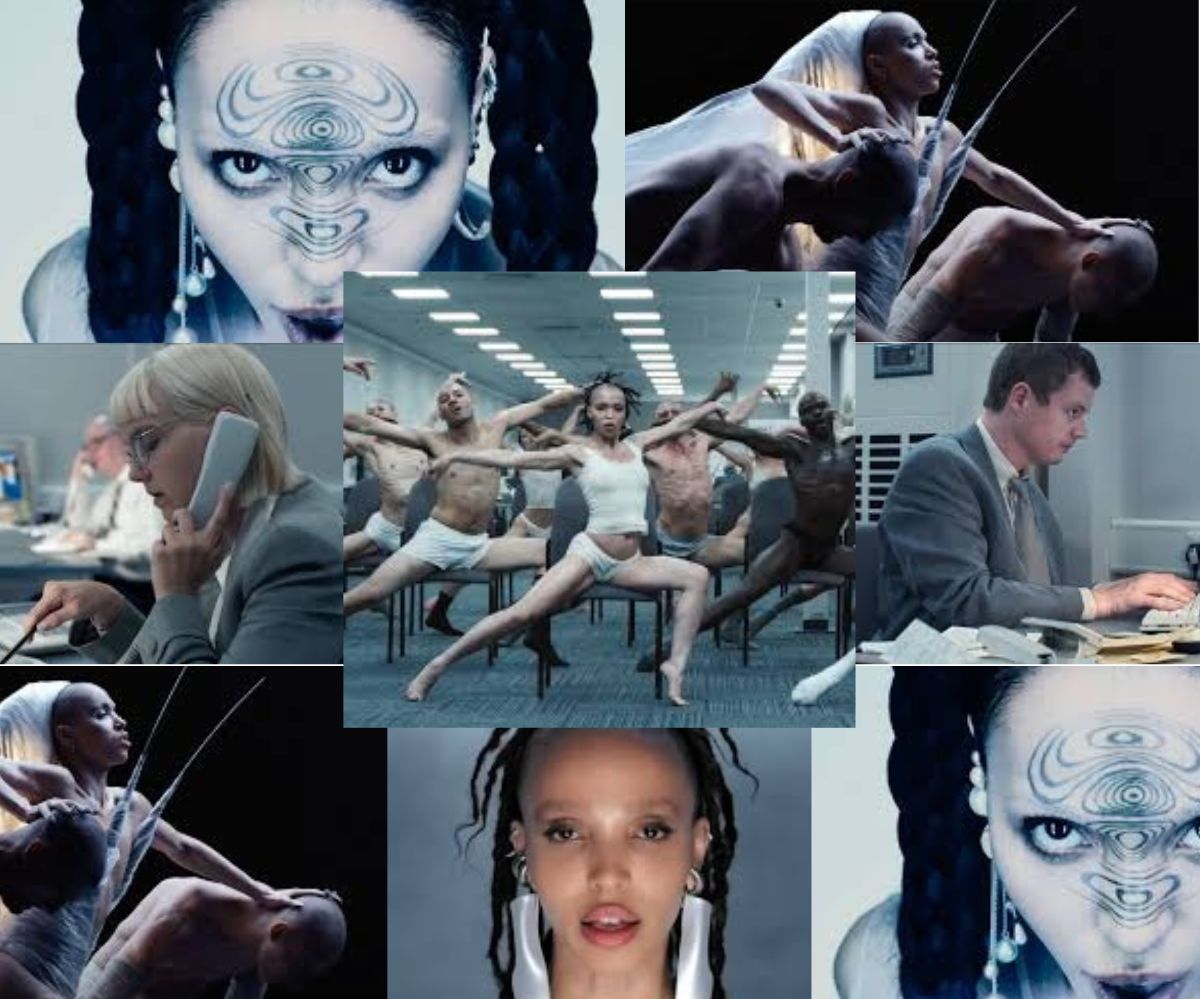
twigs echoes the philosophy of eusexua in “Room Of Fools,” a dance track reminiscent of Debut– and Post-era Björk with its feminine-nocturnal EDM sound, but she adds her own artistic twist to the sound so as not to be too derivative. The whole of Eusexua frequently dips in and out of the dancefloor to let its ideas soak in with the listener, but “Room Of Fools” is an undeniable, up-tempo invitation to move your feet. She describes those on the dancefloor as “open wounds, just bleeding out the pressure, and it feels nice.” It’s a unifying statement and love letter to rave subculture while sonically reflecting the experience of eusexua perfectly.
As the track dips into the chorus, the drums vanish, leaving only diminished strings and twigs’ voice before a sharp synth riff takes the lead, inviting the percussion in once again. The melody is full of bliss and freedom, simultaneously nostalgic and futuristic.
Eusexua never lets you get too comfortable with its tracks. The production evolves quickly, introducing elements for just the right amount of time to appreciate them. The thumping drums of “Room Of Fools,” for example. feel miles away from the quivering vulnerability of “Sticky.” Consistent across twigs’ songwriting is her exacting control over how metaphorical or literal she wishes her lyrics to be, dipping into metaphors seen on her sophomore album MAGDALENE right to confrontational, upfront statements of her current emotional state.
Over a subdued piano melody, she lays her frustrations out for the listener: “I’m tired of messing up my life with overcomplicated moments / and sticky situations.” It’s to the point, but on the bridge, she expresses herself further as the track switches instrumentally: “My body wants to be touched in the deepest and darkest places. / I want to be loved.”
Eusexua’s songs all pack a distinct punch, but among the strongest is undoubtedly “Striptease,” a career-defining track if there ever was one. Twigs owns her own vulnerability on this track, dressing it up and likening emotional openness to a striptease.
“I’ve got a birthmark on my mind, I think you’ll like it,” twigs calls out, signalling her wish to expose hidden parts of her psyche to her lover. Also noteworthy are the lines: “Silk for my tears, and lace for my fears / I’m stripping apart ‘till my pain disappears. / Opening me feels like a striptease.”
She’s waving the flag in our face that her vulnerability no longer controls her. She owns every bit of it, dressing it up before fully revealing her authentic self to her lover. The track’s sensual downtempo instrumentals emphasize the act of revealing one’s emotions to another as more intimate than any physical act of intimacy. It’s a liberating statement piece within the album.
For all its grand moments, Eusexua ends quietly on the track “Wanderlust.” True to the title, the verses on this song play on the common idea of wanderlust, addressing twigs’ desire to travel unabashedly with an openness to the fullness of any experience brought her way. The track draws to a close with the slow fade-out of the line: “I’ll be in my head if you need me.” This could be interpreted in various ways. It could be taken as a message to the listener that twigs has reached a place of full self-confidence and authenticity; whether she’s in the studio or a rave, she’s more in touch with her own mentality these days.
Conversely, this could be a message to twigs herself that eusexua is never far and can be achieved again. It can be influenced by external situations, but it’s ultimately a sensation she must recognize within herself now.