

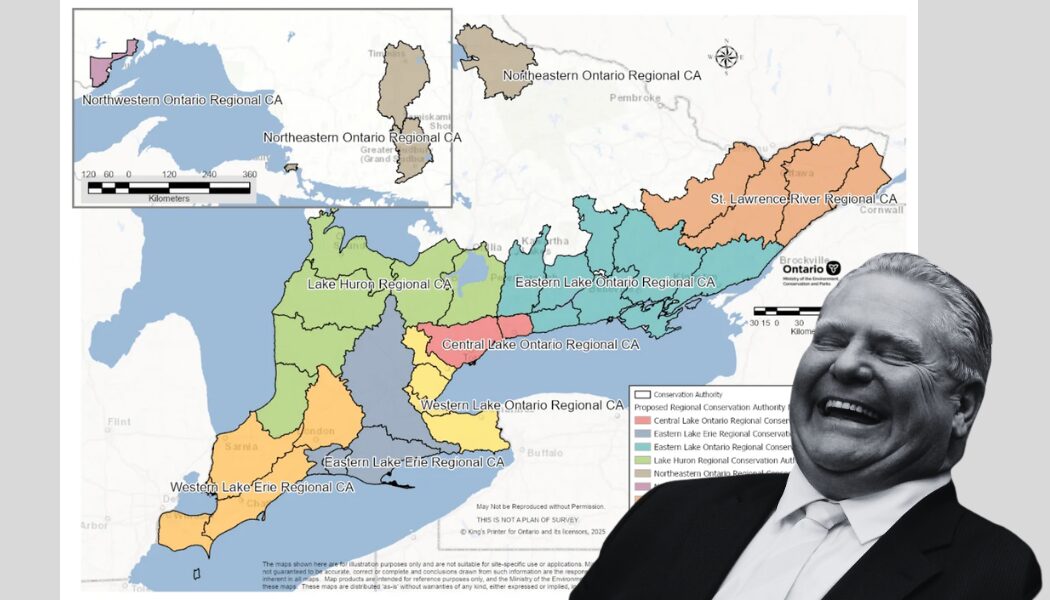
The Ontario government is facing mounting criticism over a proposal to restructure the province’s conservation authority system, a move that officials say will streamline operations while opponents say it could undermine environmental protection and local decision-making.
The province plans to merge Ontario’s 36 conservation authorities into nine larger regional bodies, scaling back from an earlier proposal of seven. The initiative, announced in March, is said to be part of a broader effort to modernize governance and support development.
According to the government, the restructuring is intended to streamline decision-making, improve consistency across regions and accelerate housing and infrastructure projects. The plan would also grant the province, through the Ministry of Environment, Conservation and parks or another centralized agency, greater authority to direct the operations of these new regional entities.
The Ontario government states that this revised model reflects feedback from earlier consultations and aims to better align boundaries with regional needs. However, details on how the new system would operate in practice remain limited.
The proposal has prompted a coordinated response from a wide range of organizations and stakeholders. A coalition including Ontario Nature, Watershed Conservation Coalition, National Farmers Union-Ontario and Federation of Ontario Cottagers’ Associations is calling for an immediate halt to the plan.
They are joined by municipal leaders, conservation professionals and a newly formed Watershed Conservation Coalition. In a media release shared with The Brock Press, these groups said that the proposed changes risk dismantling a system that has functioned effectively for decades. They raise several key issues, saying the consolidation would limit local decision-making, ignore science-based watershed knowledge and ultimately put communities at greater risk of flooding and water quality issues while dismissing concerns from a broad spectrum of organizations and thousands of Ontario residents.
Conservation authorities in Ontario were originally designed to operate at the watershed level, with governance rooted in local municipalities. The coalition members state that consolidating them into larger regional bodies and increasing provincial oversight would erode this local foundation.
They warn that decisions affecting specific communities could become more centralized and less responsive to local conditions.
Another major concern is that larger administrative regions may not align with natural watershed boundaries. Conservation authorities have historically been structured around these boundaries to ensure effective management of water systems.
Experts caution that expanding jurisdictions could make it harder to monitor environmental conditions and respond quickly to issues such as flooding or erosion.
In the media release shared with The Brock Press, the Chair of Essex Region Conservation Authority and Councillor of Town of Amherstburg, Molly Allaire, said, “the environment does not answer to government decisions; it sets its own boundaries and rules. We are not its masters — we are its stewards, and it is time we start acting like it.” Allaire continued, “we’ve followed all guidelines, submitted to the ERO, gathered letters of support, and delegated — we are speaking up to get your attention.”
While the government states the overhaul will speed up development approvals, the CEO of Federation of Ontario Cottagers’ Association, Lesly Lavender, said “the scope and scale of this consolidation will not deliver improved consistency or customer service. Instead, it will weaken local watershed expertise, dilute community representation and disrupt nearly 80 years of successful Conservation Authority operations.”
Janet Stavinga, Vice-Chair of Rideau Valley Conservation Authority and Mayor of Goulbourn Towship, further stated that “the province has failed to explain why this consolidation is necessary.” Staviga continued, “their desire to push forward with such a drastic consolidation will create more uncertainty and increase risks for our communities.”
The coalition’s media release also questions the underlying rationale for the changes. They note the absence of a detailed business case demonstrating how consolidation would improve outcomes.
Tony Morris, Conservation Policy and Campaigns Director of Ontario Nature, emphasizes the importance of maintaining localized expertise, as conservation authority staff are typically specialists in watershed science, land-use planning and flood management — knowledge that could be diluted in larger, more centralized organizations. In the media release, Morris stated, “this proposed consolidation undermines [conservation authorities] vital role in protecting our communities. We need to empower them to do their work independently as our watershed experts.”
Ontario’s conservation authority system dates back to the 1940s and gained prominence following disasters such as Hurricane Hazel, which exposed the consequences of poor land-use planning and inadequate flood control.
These authorities were established to manage flooding and erosion, regulate development near waterways and protect ecosystems at the watershed level. Their structure, based on natural drainage areas rather than political boundaries, has long been considered a defining feature.
With flooding identified as the province’s most costly natural disaster, the coalition argues that maintaining strong, locally informed watershed management is increasingly important.
The President of National Farmers Union Ontario, Josh Suppan, adds that the consolidation “threatens the livelihoods and conservation efforts of farmers and Ontarians as a whole.” Suppan continues, “we oppose legislative and regulatory changes that erode protections for farmland and natural heritage lands, and diminish transparent, democratic decision-making.”
The debate over conservation authority consolidation reflects a broader tension in public policy.
For the provincial government, centralization is positioned as a path to more efficient, quick and consistent development. For critics, the same approach raises concerns about the loss of local expertise, weakened environmental safeguards and unnecessary disruption to a system they argue is already working.
The government has not indicated whether it will pause or revise the proposal. However, with opposition growing and becoming more organized, the future of Ontario’s conservation authority system is likely to remain a contentious issue in months ahead.