

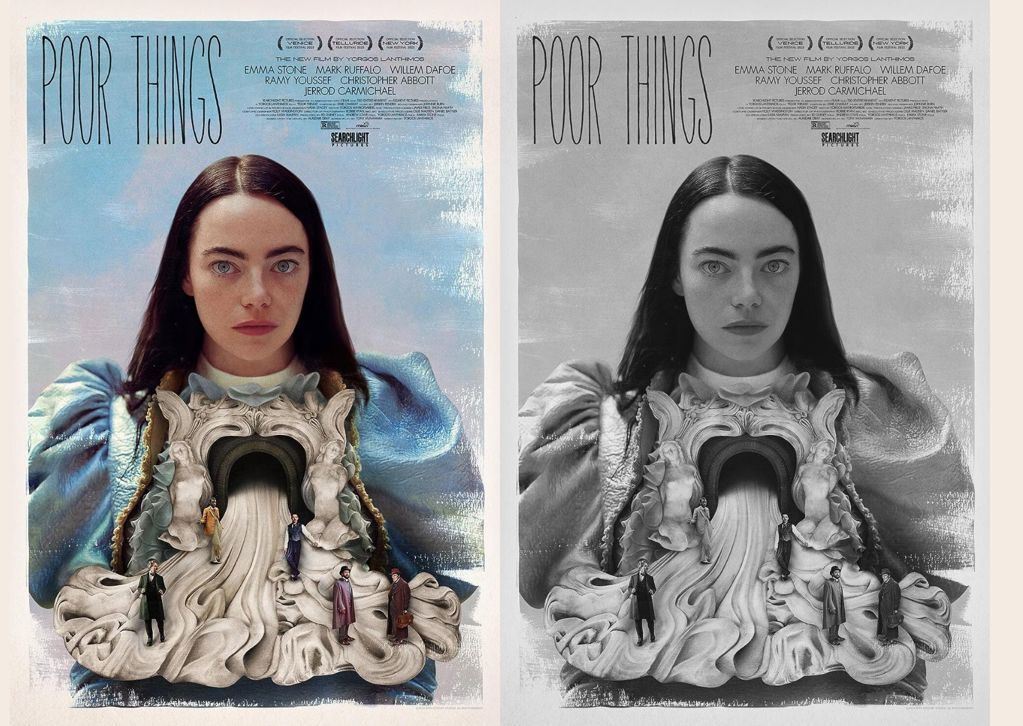
The latest film by Yorgos Lanthimos is a feast of philosophy, lust, sex, humour and tenderness.
Lanthimos is widely regarded for his unusual films, ranging from The Lobster and The Favourite. In all of their whimsicality, they are typically grounded in the real world. His characters are often oxymoronic in a way that challenges conventional understandings of people: they may be stiff and confused or wildly unpredictable. In Poor Things, Lanthimos goes beyond his already idiosyncratic comfort zone to craft something that feels unique, fleshed out and irreplicable.
Poor Things follows the journey of Bella Baxter (Emma Stone), a woman brought back to life by extraordinary scientist Dr. Godwin (Willem Dafoe). Her reborn child-like brain rapidly develops and she starts wishing to explore the outside world beyond the confines of the doctor’s austere manor.
As such, she flees with the egotistical lawyer Duncan Wedderburn (Mark Ruffalo) and embarks on a journey around the world. On this grand expedition she explores the pleasures of sexual liberty, the nuances of love and ways to find joy in a world brimming with cruelty.
It would be impossible to review Poor Things without mentioning its exquisite cinematography. The film often alternates between different lenses. Typically, when a scene is set inside a large room, an ultra-wide-angle lens is used to emphasize the dimensions, giving it an unusual doll-house quality where actors are positioned like dolls themselves. Wide-angle lenses are also used in outside settings to make the characters feel small and the background expansive. This technique is stimulating for viewers, creating adraw to explore every corner of a shot and swim through the visual delights they offer.
The worldbuilding is essentially flawless in the film. It’s idiosyncratic but never comes across as unnatural or forced. Bella visits several cities on her expedition such as Lisbon, Paris and London. The film transforms these cities into surreal versions of themselves yet still manages to capture their essence: the bustling port of Lisbon; the gloomy chic of Paris; the progress-driven London. This gives the world a sense of familiarity and offers some grounding in reality, but still feels like something unfamiliar that calls to be explored vicariously through Bella.
Stone knocks it out of the park as Bella in a career defining role. A character as bold as Bella could only be brought to life by someone as committed to their craft as Stone is here. She nails the evolutionary quirks and alterations in behaviour as Bella grows and adjusts to the world around her. Her growth from a child-minded, Frankenstein-like character to a woman wrapped in existential reflection is a 180-degree revolution evolution that Stone nails without ever feeling cartoonish.
The performance is eclectic but never feels offensive or out-of-touch. If anything, she ensures that Bella is a character whose development is so all-encompassing in the film that the audience may leave the cinema feeling as though they have grown alongside her. On top of this already, the excitement she gives Bella is contagious. It’s hard not to be wrapped up in the reactions she has to new phenomena, a feeling that can best be compared to the euphoric sensation of being drunk for the first time.
As usual, Stone delivers comedic lines masterfully. This is partially due to the film’s witty script, but the timing and tone she gives to the humour will evoke well-earned laughs from audience members. The sheer level of thought she put into this role makes Bella Baxter one of the most fleshed-out characters in recent cinema and arguably one of the greatest acting performances of this decade so far.
An overarching theme of sexual liberty through a feminist angle is present in Poor Things, however it never comes across as forced, patronizing or preachy. The film conveys it in a way that is digestible on account of Bella’s own development and compartmentalization of ideas. She is a woman exploring the world for the first time, learning what it means to be a woman and be perceived as one.
Despite her growing alertness to societal conventions that seek to control her womanhood, sexuality and autonomy, she never hesitates to question enforcers of the status quo, or literally spit in their faces.
Although themes of sexual liberty act as a thematic foundation for the film, it ultimately seeks to use these to ask questions of what true liberty really is. As Bella grows and explores the world, her idea of freedom is questioned.
Initially, freedom to her is being able to gaze at the outside world from behind a locked windowpane in Godwin’s house. As she circumnavigates the outside world with the company of various partners, her own understanding of freedom is questioned alongside the audience’s.
Perhaps what Lanthimos is aiming at, is that what we believe to be freedom is imprisoning us from something larger that calls to be explored. The film subtly entertains this idea but never shoves it down the viewers throat. Like Bella herself, the films is merely bouncing from one idea to the next, living in each one to the fullest and indulging in the intellectual pleasures it can tease out while leaving open the idea that our notions of freedom are constantly shifting.
Films like Poor Things are rare delights to cinema, a true balance of tastes whose flavours know when to dance on our tongues and when to bite back. It combines the aspects that make Lanthimos’ films iconic and brings them to an entirely new level.
Beyond its perverse oddities, Poor Things is a refreshingly empowering and heartfelt story about a woman charting her course to freedom and learning how to find beauty in all the ugly chaos of the human experience, making the act of living worthwhile.