

Score: 4/5
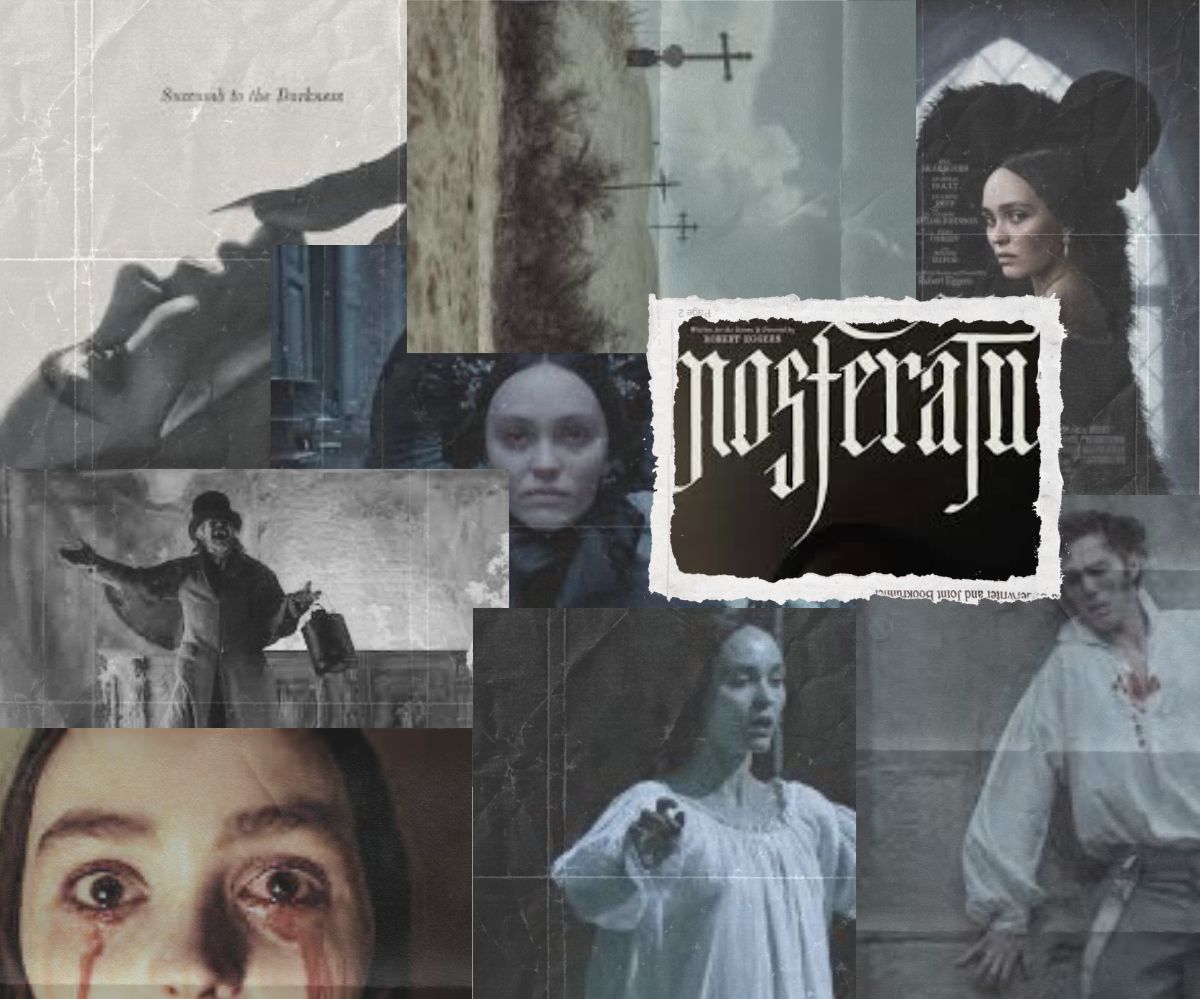
“Does evil come from within us or from beyond?” Robert Eggers’ Nosferatu asks with all the gothic horror immersion needed to portray such a question on the big screen effectively.
How capable are we of committing atrocities? Do we have it in us to do such a thing, or are we pushed to do so by the environments of our world?
When filmmaker and widely acclaimed horror auteur Robert Eggers announced he was working on a rendition of the classic vampire story Nosferatu, it sparked immediate life into the horror community. For many, Eggers has established himself as a reliable but exciting director with a distinct style and eye for the craft of filmmaking. After years of waiting, Eggers finally released the film on Christmas of last year.
Originally a silent film and illegal adaptation of Bram Stoker’s gothic horror novel Dracula, Nosferatu tells the story of Ellen Hutter, a young woman haunted by the shadowy Count Orlok, a lustful vampire. After emigrating from his home in Transylvania and acquiring an estate nearby, Ellen’s connection to the count grows stronger, resulting in devastating consequences to the world around her.
With three acclaimed, beloved films under his belt (The Northman, The Lighthouse and The Witch), Eggers is guaranteed a loyal fanbase, but adapting a story as prolific and well known as Nosferatu was never an easy task. Furthermore, Dracula, the source material, has already been adapted numerous times in cinema.
Despite these daunting odds, Eggers crafted an exquisite, sleek rendition of the tale that feels equally dedicated to honouring the story’s history as it is to introducing a fresh take on it.
The film’s tone is matched by its dim lighting. Scenes are often lit solely by the dim glow of candlelight, shrouding spaces in darkness. This choice is simple, but greatly helps with immersion, and is a strategy Eggers has used in his other films. The film also uses backlighting to create silhouettes and a pale-blue, unsaturated tint to scenes, creating a black-and-white effect that pays homage to the original 1922 silent film.
A notable characteristic across Eggers’ filmography is his consistent, unwavering control over mood and atmosphere. Each film incorporates camerawork, lighting and direction in ways that serve the needs of each respective story. Nosferatu is no exception, being perhaps his most stylish film to date with some of 2024’s most visually stunning shots. The synergy of style and expertly shot scenes shines right from the film’s first act when Ellen’s husband Thomas, played by Nicholas Hoult, embarks on a foreboding journey to Count Orlok’s home, a gothic castle tucked away in the shadowy, jagged peaks of Transylvania’s mountains.
Throughout many cultures, vampires have long been associated with eroticism. The act of surrendering oneself and one’s blood — a source of life — to an inhuman being is a thought both exciting and terrifying. It is a symbol of forbidden desire shunned by societal norms. In many modern vampiric tales, the vampire is depicted as incredibly humanoid, removing some of the fear and monstrosity associated with these creatures.
Eggers’ rendition of Count Orlok, played by Bill Skarsgärd, dismantles all associations with conventionally attractive appearances of vampires brought about by stories like Twilight. Here, the vampire is something to fear: a monstrous undead beast with an appetite for blood whose sole purpose is to absorb the life energy of humanity. He is more physically imposing and commanding of space than previous iterations, such as the 1922 version. Unlike Count Dracula and other renditions of vampires in fiction, a bite from the Nosferatu does not grant victims a chance at undead life. He is a predator in the food chain with the intent to kill and feed.
Lily-Rose Depp literally puts her whole body into an impressive, physically demanding performance as Ellen. Like all good possession-horror performances, she contorts, writhes and utters inhumane noises, but in quieter moments, she manages to control how much she wishes to reveal about her character’s troubled emotional core.
Perhaps a greater sickness than the plague the Nosferatu brings to humanity is the all-consuming sexual shame that devours Ellen following her initial encounter with the count. Not even a loving husband or devoted friends can free her from it, her connection to the Nosferatu is the only catharsis she is granted for feeling this shame in day-to-day pleasant society.
A Nosferatu is a loathsome, possessive beast that torments her as much as he gives her the freedom to feel this shame. He is a monstrous destroyer of innocence that ultimately recognizes Ellen’s desire, symbolizing the demonization of sexual deviance in a world guided by the condemnation of sin. Count Orlok may consume blood to satiate his physical desires, but Ellen’s shame is his lifeline to her. He hungers for her, feeding off her shame in hopes that she will surrender herself to him.
This reintroduces the initial question: is Count Orlok, the Nosferatu, a supernatural entity conjured by Ellen’s own internal nature or something beyond her very being that caused her to feel this way? The answer is never clear-cut.
Orlok is both a manifestation of evil and Ellen’s shadow: a reminder of the shadows slithering within all of us, the desires and curiosities we crave to fulfil. Perhaps we satisfy these desires by engaging with art, analyzing and dissecting stories of violence, horror and suffering. We are expected to remind ourselves that these stories are fictitious, thus removing us from a degree of accountability for engaging with them. But in doing so, are we merely controlling what naturally lurks inside us?
Nosferatu asks us if we have the courage to confront our capacity for darkness and the hidden parts of ourselves the world may deem abhorrent. Perhaps doing so may be the only antidote to combat far more tangible evil lurking in the peripheries of our world.