
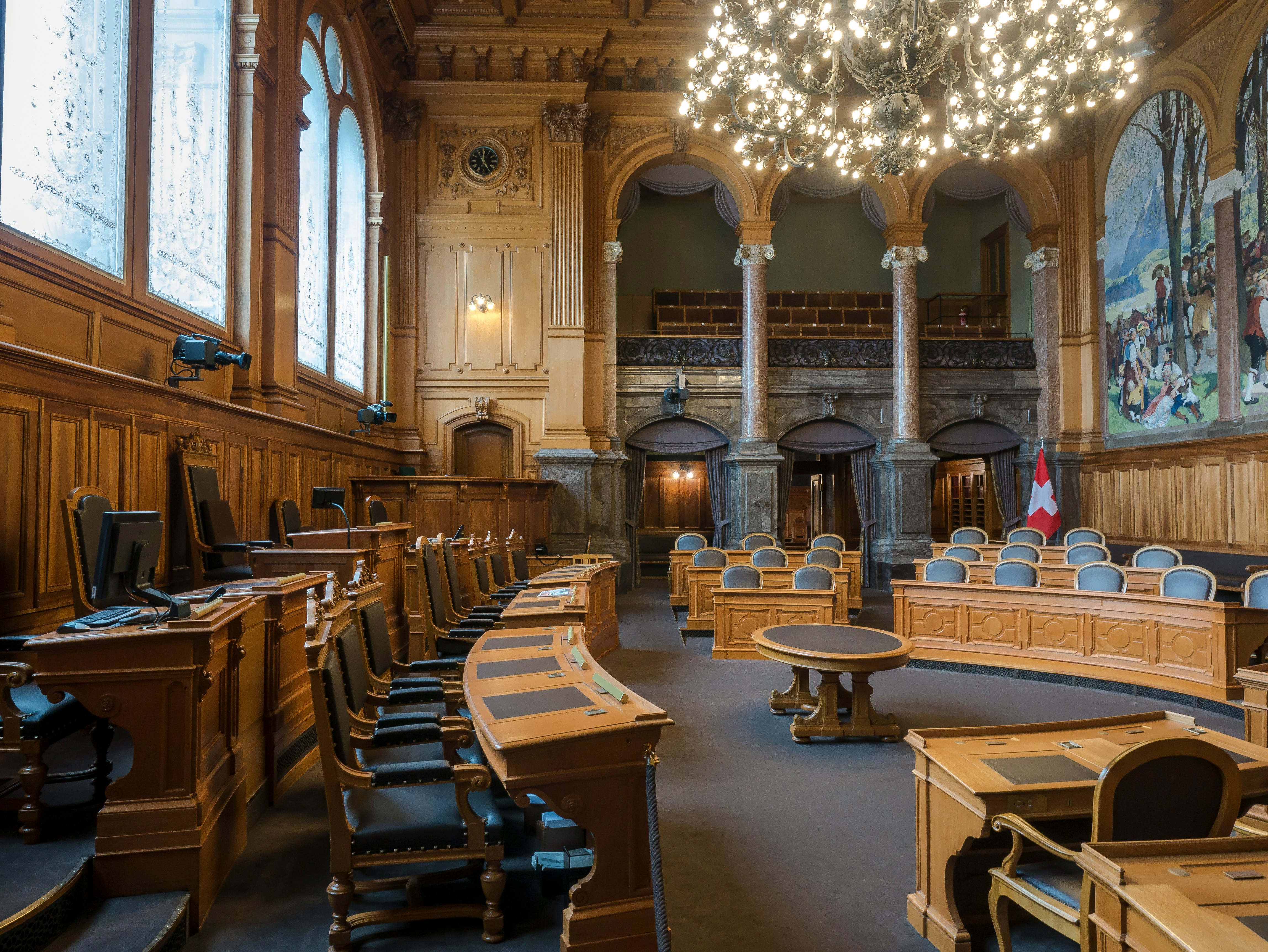
On Jan. 24, on a frigid morning during a cold snap and with just four hours of sleep, I embarked at 7:40 a.m. to meet my partner in crime, Wenyang Ming, for my first mock moot court trial.
After I had covered Amicus Curiae a while back, Ming asked me if I would be interested in competing in a moot court. For those who do not know, a moot court deals specifically with the application of the law in analyzing a legal judgement.
For example, a moot court could deal with whether the denial of an appeal was valid by testing the legal reasoning of both the appellant and the respondent’s side, which is explained further in the Amicus Curiae article.
At the time, I hadn’t really considered what it would be like to compete in a mock moot, though Ming told me that it is a mildly significant time investment, saying that at the very least. Participants had to be able to dedicate several days to preparations.
Naively, I assumed the necessary time to prepare could be found somewhere in my schedule, and so, Ming and I partnered up to compete in the upcoming Gryphons Cup competition.
I was unable to find time. Between exams, my lack of foresight and a host of other commitments, the date of competition crept up faster than I expected. Ming and I would meet occasionally at the end of the day, near midnight, at the 24 hour McDonalds on Schmon Parkway to read as much as we could before getting tired.
Through those sessions, I developed a relatively general understanding of the case at hand: one R v. Bharwani, which in sum, involved the denial of an appeal to adduce two new pieces of evidence in the trial of Bharwani, who had been charged with first degree murder for the killing of his roommate.
Both pieces of evidence related to how Bharwani had been suffering from mental illness, and a key aspect of the trial was determining whetherBharwani could be held criminally responsible due to his mental state.
In Canada, to be charged with murder, one needs to prove criminal intent (mens rea) in conjunction with the physical action (actus reus), otherwise the act could not be considered a crime.
During the trial, the Crown relied heavily on the testimony of Dr. Woodside, a rather infamous figure who had gotten himself into trouble with unorthodox note taking in R v Minassian, and who was called out for professional credibility bias in R v Nettleton.
Dr. Woodside was one of three expert witnesses called and the only one who found Bharwani criminally responsible, a testimony which the jury chose to place stronger emphasis on.
Bharwani sought to add new evidence of Dr. Woodside’s alleged unreliability in his appeal. In addition, the Crown had ordered a new expert witness, Dr. Chatterjee, to examine the circumstances of the accused. Dr. Chatterjee’s testimony aligned with the other two expert witnesses in the case that Dr. Chatterjee found Bharwani to be not criminally responsible.
I was thinking over the complexities of the case as we barreled down the QEW bound for Guelph. I was wearing a comfortable pair of jeans and a wool pullover with a not particularly nice striped oxford shirt underneath.
Ming and I were just on time. The event was slated to begin at 9:30 a.m. and we were estimated to arrive at 9:20 a.m. When Ming suddenly asked me if I had brought my formal clothes with me, I froze.
In glancing over the competitor’s package, I had neglected to check the clothing requirement. Ming, on the other hand, keeps a whole set of formal clothing in the back of his truck for whenever he needs it. In a panic over potentially docking ourselves points for formality, I suggested we make a quick stop at the local Walmart to pick up whatever pair of slacks I could find.
As soon as I had to buy slacks 10 minutes before signing in at a just-opened Walmart in Guelph, I knew that Ming and I were in for a long day.
Everyone at the Gryphons Cup was dressed to the nines in three-piece tailored suits, carrying around well-prepared case briefs and standing far more elegantly than Ming or I.
It was an intimidating environment, one that wasn’t helped by my outfit making me stick out like a sore thumb. I had never felt so out of place in my life in my Walmart slacks, a not adequate striped oxford and salt damaged Timbs.
If I hadn’t already been musing about the need to wear embarrassment with pride as a matter of growth, I’m sure the firsthand embarrassment would have been the end of me.
I’ll spare you the details, but it went terribly. My only consolation on that front is that competitors weren’t directly representing their schools, in the sense that we were not allowed to discuss which schools we were from.
We participated in four rounds. For three rounds, we argued on the side of the respondent (Crown), and on the last round, we argued on tahe side of the appellant (Bharwani). All four rounds were equally disastrous for me, although less so for Ming.
I stuck through it. Before the competition date, I told Ming that I could only guarantee him the first round of competition: I knew I was underprepared. Ming took this in stride and was nothing but the most encouraging moot partner.
The four rounds were very strong lessons. In my first round, I recall the compassionate patience of the Justice who listened to me stumble across my arguments. In many ways I felt I was wasting her time, but regardless, she showed me grace during my turn.
In my second round, our opponents displayed fantastic sportsmanship. This was also their first time competing, and while they had come better prepared and better dressed, they nevertheless treated me with grace despite my underwhelming performance.
In my third round, the Justices became a bit harsher with their questioning, but they were fair to hold me accountable to the standards that had been set by other competitors.
In my fourth and final round, we witnessed a stellar performance by our opponents, one that tied in legal reasoning with intended legal policy that flowed from written submission to rebuking the Justices’ questions. Yet, despite our less than stellar performance, our opposition freely engaged in friendly conversation with us during deliberations.
I learned a lot from this experience. On the technical side, a mock moot requires a strong written submission to support rebuking of the Justice’s questioning, in addition to a strong understanding of legal reasoning, trial tactics like which points to argue and which to concede, and most importantly, a good suit and tie.
On the experience side of things, I wouldn’t necessarily recommend doing something like a moot trial completely unprepared, as I felt it was disrespectful to the clear effort that the other competitors had put in.
However, the experience taught me that regardless of how you prepare, people tend to be kind. More than likely, it’s okay if you are not dressed correctly, if you are not as refined as you would like to be, if you stumble across your words or if you think you look like the definition of audacity. People are overwhelmingly kind.
I was thoroughly impressed with the conduct and performance of the Gryphons Cup competitors. Brock does not yet have an established mooting society, but I believe building one would be beneficial for students interested in law, legal research and public policy. Generally, it’s a good opportunity to apply yourself.
As for Ming, he was nothing but fantastic. He provided me with a lot of courage as a first-time mooter and not once was he hard on me for my performance. Ming was a large part of why I left feeling rather positive despite my disastrous performance.
I intend to do another mock moot, most likely over the summer, and this time I want to dedicate the time it deserves.
Ming and I ended our day with a consolation prize of a third-pound of chicken wings in Guelph. My next step from here is acquiring a suit.