

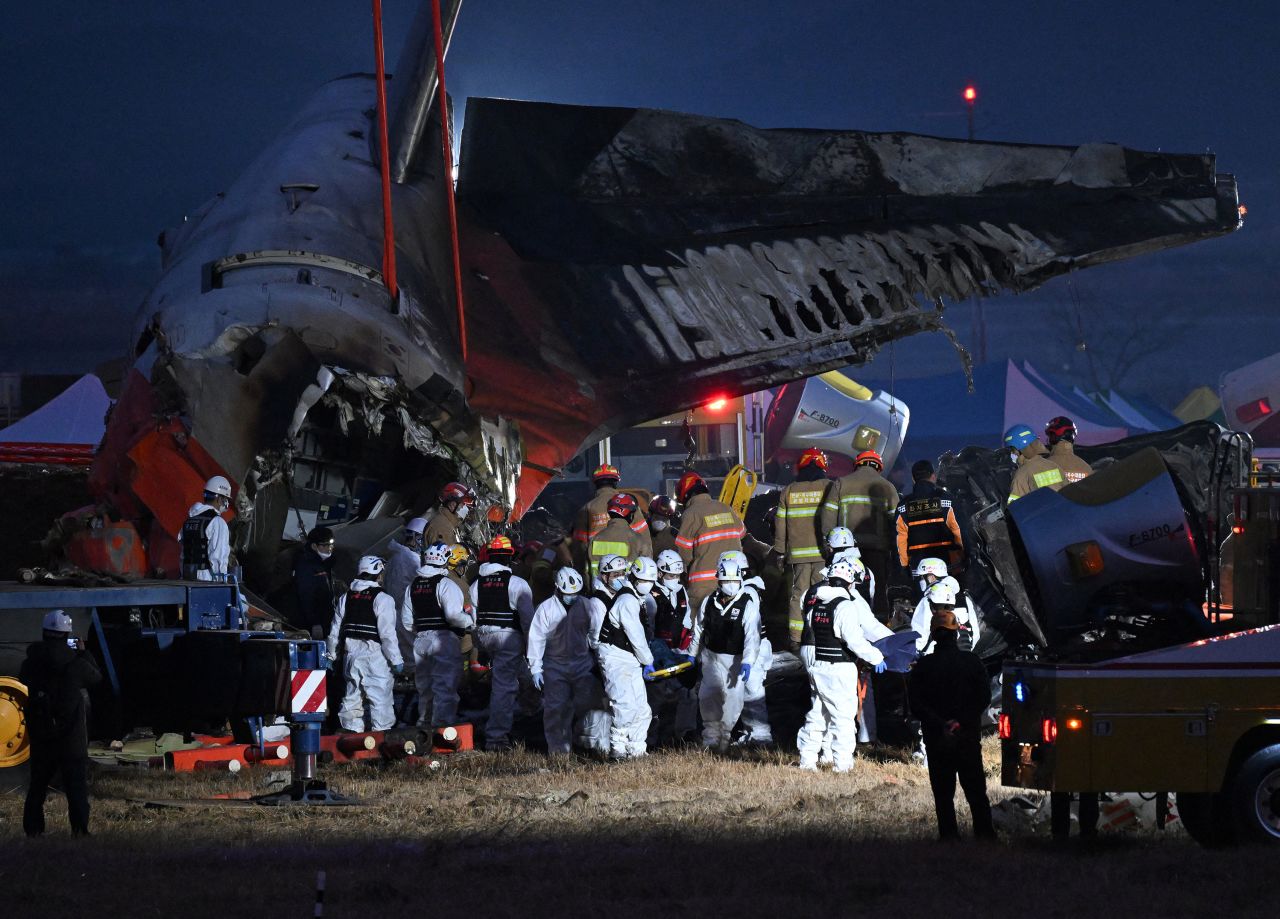
A South Korean airplane crash killed 179 people on Dec. 29.
On Dec. 29 at 9 a.m., the Jeju Air flight 7C 2216 crashed at Muan International Airport in southwestern South Korea after returning from Thailand. Of the 181 people on board, only two people survived, making it the country’s deadliest plane disaster since 1997 and one of the worst in aviation history. This wais the fifth Boeing plane crash of 2024.
According to ABC News, the pilot sent a distress signal that said, “Mayday, mayday, mayday, bird strike, bird strike, going down.” The plane ascended and made a 180-degree turn before it descended. After crash-landing at the airport, the plane slid down the runway until it hit the embankment at the end, which was used to house navigation equipment. On impact with the barrier, the plane burst into flames. The embankment housed a localiser and an antenna system that emitsted radio signals to guide aircraft toward the runway, an essential for safe landings.
Investigations are still underway concerning the late touchdown of the plane and the lack of landing gear deployed (both wing flaps and wheels).
On New Year’s Eve, the U.S. National Transportation Safety Board sent investigators to South Korea to help uncover more information on the case.
A horrifying video captures the moment of the crash.
Bird Strike
Collisions between birds and aircrafts are very common, but are very rarely linked to fatal plane crashes. Two minutes before the distress signal, air control warned the plane of a possible bird strike. Engines can stall or shut down if birds are sucked into them, but typically pilots have time to account for this. With the warning from ground control, a safe emergency landing should have been possible. The sudden 180-degree turn and lack of deployed landing gear may suggest a malfunction, and South Korea’s acting president Choi Sang-mox ordered an emergency inspection of the country’s entire airline operation system.
Choi declared a week-long period of mourning, with flags flying at half-mast. Several memorials have been set up at the location of the craft and other parts of the country.
Survivors
Both survivors of the plane crash are flight attendants who were seated by the back of the plane.
A 33-year-old man with the surname Lee suffered multiple fractures and is under special care due to the possibility of total paralysis but is conscious. Ju Woong, the director of the hospital, told ABC News that although Lee is “fully able to communicate” and there was no indication of memory loss, Lee was not yet questioned about the details of the crash at the time of writing because Ju believed it wouldn’t be helpful to the patient’s recovery.
The other survivor, a 25-year-old woman identified as Koo, is reportedly in stable condition with injuries to her ankle and head.
Hundreds of the deceased’s loved ones have been camping out at the Muan International Airport, full of grief and anger. Police superintendent Na-Won-o explained that the identification process of the bodies was slow “due to officials taking their time to carefully identify all 179 victims, whose bodies were badly damaged in the crash.” One grieving man asked if the bodies would be put back together, while another wished for the victims’ remains to be released as they were. But with some remains “too scattered to be recognised,” Na said officials wanted to do the best they could at collecting and matching as many bodies as they could.
The airline’s chief executive Kim Yi-bae said in a news conference on Dec. 31 that “the plane and its pilots were cleared to be flying before the landing.” While the reason for the late touchdown and lack of landing gear is still being investigated, many blame the airport for the disaster. According to Forbes, the airport’s 2024 operating manual acknowledged the embankment was “too close.” CEO of Aero Consulting Experts Ross Aimer told Reuters that the embankment was the central reason for the disaster, and it “shouldn’t have been there.”
Kim says the families will be compensated, but that does very little to dim the tragedy for the victims’ loved ones.