

4/5
The Last Faith is an exciting blend of the metroidvania and soulslike genre, even if it doesn’t do much to push the boundaries of either.
I’ve only played three hours of the new game so far, which was released on Nov. 15, but I am itching to progress the plot, explore the world of Mythringal and level up the main character, Eryk.
The main draw of this game was that it claims allegiance to two heavy-hitting genres, soulslike and metroidvania. For those not aware, metroidvania is a genre whose name derives from the games Metroid and Castlevania, in which the player explores a broad, interconnected 2D or 2.5D map through platforming. Instead of starting with everything, upgrades to increase combat and exploration potentials are slowly given to the player as they progress through the game.
Shovel Knight and Star Wars Jedi: Fallen Order are examples of the soulslike, a genre inspired by FromSoftware’s soulsborne games: Dark Souls, Bloodborne, the recent titan Elden Ring and others. These games promise brutal, unforgiving combat, exploration of a large map, strategic boss fights and a steep difficulty curve. There’s no selecting the difficulty in these games: if you can’t beat a section of the game, you don’t finish the game.
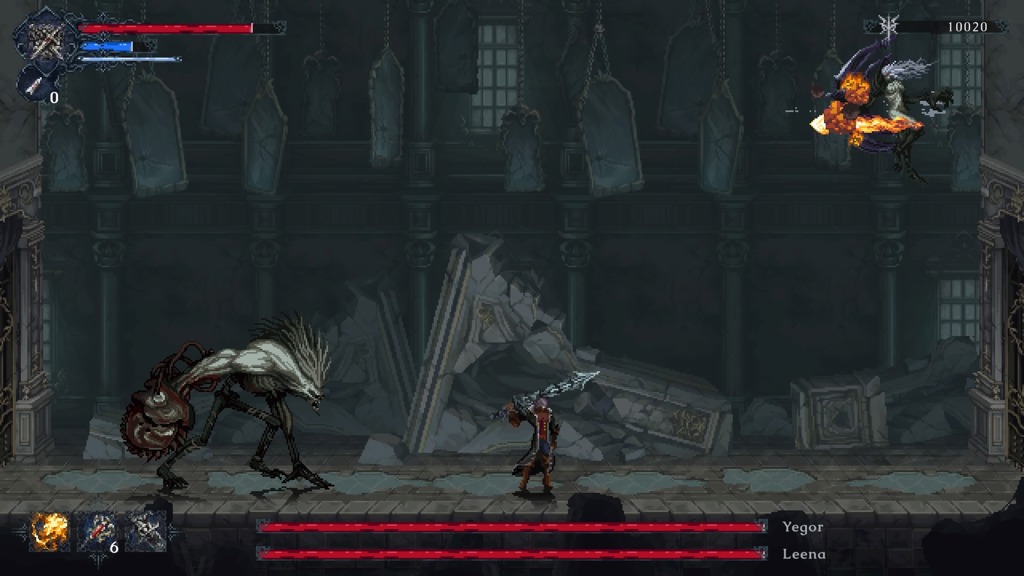
The Last Faith mixes both genres in a satisfying way. It has 2D graphics very akin to the recent Blasphemous and an extensive map, but game mechanics like Bloodborne, with multiple weapons to choose from, a level-up system revolving around souls collected from enemies—called Nycrux—and an unforgiving difficulty.
Not every gamer will be a fan of the unrelenting difficulty in a game like this, where the player is required to master the mechanics and gameplay or suffer. But for those who do, The Last Faith delivers satisfaction. Regular enemies can kill you if you aren’t careful, and when you die, you can only recover your Nycrux if you return to the spot where you died. If you die again before recovering your Nycrux, it disappears forever.
Temporary checkpoints make progression easier, giving the player a spot to reload when a significantly difficult area lies ahead. This allows the player to tackle said areas with max health and consumables, but these checkpoints cannot be fast travelled from, meaning if you run out of health elixirs or bullets, you’re out of luck.
That’s one of the aspects of The Last Faith that I’m still on the fence about. Health items are consumable—as opposed to regenerative at checkpoints, such as in games like Hollow Knight or Dark Souls—meaning they can run out and leave you in a dire situation. However, these items are often dropped by common enemies, and they can be bought for relatively cheap at Oxnevylle’s Manor, the game’s hub. Getting stuck in one area means you’ll run out of these essential items, but the interconnected map allows you to travel back to easier areas and farm for Nycrux to level up, stock up on those items and tackle the tough area again.
The graphical style of The Last Faith is very similar to Blasphemous, so much so that when I saw gameplay while it was still in early development, I thought it was a direct sequel. Blasphemous was a staple of the genre, though, so imitating it is normal. However, The Last Faith substitutes twisted Catholic imagery for an atmosphere dripping with the gothic and macabre, featuring classic ominous castles and crypts. In this regard, it resembles another genre standout, Castlevania: Symphony of the Night.
The Last Faith has brief cutscenes that are again heavily inspired by Blasphemous, but conversations with NPCs feel more fleshed out, with enlarged cutouts of the characters that feels more akin to a visual novel. The conversations are not long-winded either; they gave just enough information about the plot to keep me interested, but not overwhelmed. The focus in The Last Faith, as it should be in my opinion, is on progression and exploration.
Some standouts in the metroidvania genre, like Hollow Knight and Super Metroid, pride themselves on being completely open world. The progression route is not predetermined, but rather based on what decisions the player makes. The Last Faith is more linear thus far, but there are enough secret areas and locked doors I cannot yet access that I know will require backtracking. In this case, though, the backtracking feels refreshing, like in Super Metroid, rather than a slog.
In a game like this, if the combat isn’t fluid and fun, the game doesn’t work. Luckily, The Last Faith’s combat is satisfying and progressive. As I mentioned earlier, there is a wide variety of weapons and spells to build your arsenal from, and like other soulslike games, ability points gained from level-ups can go into whatever element of your character you want to flesh out more, whether that’s Vitality, Strength, Dexterity, Mind or Instinct.
The combat is heavily based on dodging rather than parrying or blocking. Where I stand in the game, I cannot block whatsoever and parrying requires precise timing and energy, which runs out. Dodging, however, is fluid, especially since most enemies don’t give damage when you bump into them. It’s easy to get locked into damage by trying to jump away from an attack, but I learned that after the first boss fight.
I’ve only beaten three of the game’s 20 boss fights, and so far I’ve found them challenging but fair. The very first boss gave me the most trouble since I wasn’t used to the game’s mechanics, but I managed to beat the second and third in two or three attempts each. They’ve all had different movesets and strategies, and they’ve all had one weakness or another. From the screen captures I’ve seen of the game, I know there are some awesome ones waiting around the corner.
I’m not entirely sure what’s going on in the plot. Eryk is trying to cure himself of a strange, divine affliction that may drive him mad—like how the main character in Dark Souls is trying not to turn Hollow—and in order to do that he’s searching out NPCs based on the directions of other NPCs. The beauty of a game like this is that understanding the plot isn’t very important, rather the emphasis lies in combat, exploration and gameplay.
I’ve had a difficult time turning off The Last Faith. It’s fun to play, and so far it hasn’t made me want to tear out fistfuls of my own hair. So far. But even if it does, I know I will keep dying and retrying and failing and learning because again, The Last Faith is fun. It’s true to both the soulslike and metroidvania genres, and I’m eager to keep playing.