

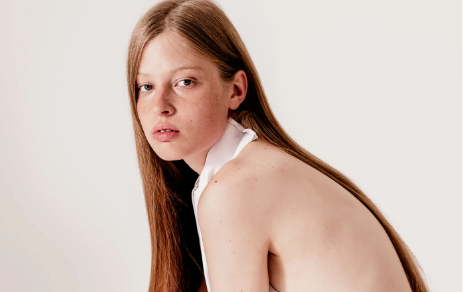
Desigual, a fashion company based in Barcelona, released its newest ad campaign with Vivian Wilson. Though artificial intelligence (A.I.) seems to have an ever-encroaching influence on the world around us, Desigual and Wilson make their statement clear: it belongs nowhere near the art world.
Desigual’s campaign revolves around the slogan “Born to disobey.” The statement at the beginning of the editorial reads as follows:
“Authenticity over perfection. A pulse that rises above the machines, born from the same free, radical spirit as Desigual itself. She doesn’t fight the system; she refuses to belong in it. In a world full of rules, authenticity is the most radical choice. Born to disobey.”
Throughout the editorial, Wilson is shown destroying her robot companion in various ways, emphasizing its fragility. In one ad, she repeatedly batters and bullies the robot, attempting to make it say Desigual, which it can never do. “It’s easy,” Wilson says, looking smugly at the viewer.
It would be remiss not to mention the significance of Wilson as the face of this campaign. As a trans woman who is also the estranged daughter of Elon Musk, her identity is integral to the campaign’s principles of authenticity and breaking the binary and rules of modern society.
Musk’s influence on A.I. and technology in recent years has become evident and heavily politicized. With his involvement in the Trump administration and conservatism, his public image has made him a central figure, representing a dystopian technological future people fear.
Musk’s purchase of Twitter (now X) eventually resulted in the creation of his new generative A.I. tool, Grok. Grok encourages users to tweet directly to it and ask whatever questions they may have. Grok has been less rigid in its regulations than many other A.I. platforms. One of the main consequences that have come from this is Grok’s ability to create deepfakes.
Users can prompt Grok to change outfits, facial features and body shapes of celebrities and normal users on X. This feature has primarily impacted women. One user told The Huffington Post about a post she made wearing a dress. The post was met by users who requested Grok to strip her down to a bikini. Grok complied. With this, Grok has also been accused of being used to generate child sexual abuse material from real photos.
Living in a world where this technology is so accessible is concerning for many, as it can impact every facet of daily life. The art world is especially concerned with how these futures will intersect — and how they have already begun to.
In fashion, A.I. has become an increasingly popular tool. Brands like L’AGENCE have begun to use A.I. to allow users to virtually try on items before purchasing. Perhaps more nefariously, companies have begun allowing A.I. to replace models. Recently, an ad from the brand Guess appeared in Vogue, with A.I. models.
Plus-size model Felicity Hayward explained in an interview with the BBC that she was disheartened by the uptick of A.I. models. She expressed concern that the future of A.I. in modelling will disproportionately impact plus-size models.
Hayward’s fear raises an important question of whether this technology disproportionately impacts marginalized groups in shaping a new beauty standard.
Desigual’s campaign rejects the idea that A.I. is the new normal for the fashion industry. Instead, Desigual embraces imperfections and authenticity, using Wilson as the catalyst to show this.
In an interview with New York-based writer Dylan Kelly, Wilson told him, “If we sacrifice everything for the name of progress, I question how usable or feasible that progress really is. The issue of A.I. art, for one, you’re feeding paper to a printer and then acting like you invented the press. It takes away that emotion, that soul, that art inherently has.”