

Vogue’s recent commentary on heterosexual relationships is just plain old misogyny and gender essentialism redressed as feminist empowerment.
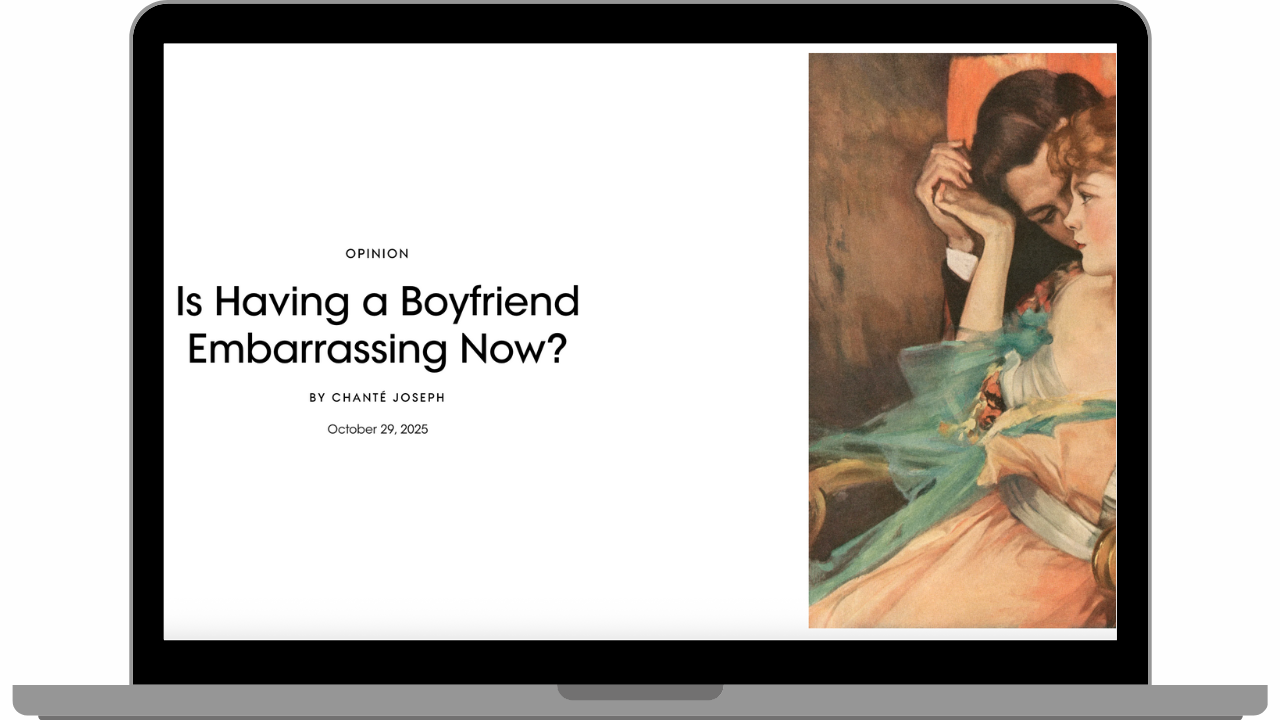
On Oct. 29, Vogue magazine contributor Chanté Joseph published a piece exploring the response to women displaying their heterosexual relationships online. In the opinion article, “Is Having a Boyfriend Embarrassing Now?” Joseph attributes the recent trend of “soft launching” relationships on social media to a widespread fear among heterosexual women specifically that they will be regarded as “culturally loser-ish” if they proudly display their male partners online.
According to Joseph, once a woman enters a relationship with a man, her social media content usually becomes “’my boyfriend’-ified,” shifting to revolve around her new partner to an overwhelming degree and “suffocating” her followers with her boyfriend’s presence. Thus, as Joseph implies that it is a universal experience to bear witness to another woman obsessively posting her partner, many women retreat from posting their partner in fear of seeming “boyfriend-obsessed,” hence the origins of “soft-launching.”
Joseph connects the alleged embarrassment of one’s male partner to a recent cultural shift marked by interrogating our “blind allegiance to heterosexuality.” She notes that the annoyance that some women say they feel towards seeing others post their male partners online is rooted within an urge to retreat from “boyfriend land,” wherein women’s online personas revolve solely around their boyfriends. She says that some women immerse their social media pages in said “boyfriend land” to bring themselves to a higher social regard and receive “praise” or even make “financial gain[s]” by leveraging their great success of locking down a man.
Now, these are some heavy-handed accusations. To me, a person would have to be particularly dubious to consciously exploit their partner online for the sake of acclaim and money, though it is unclear whether the women she is referring to are doing so consciously. To claim that large swaths of women are meticulously using their partners in such a way illustrates some unsavoury images that are mysteriously reminiscent of misogynistic myths that construct women as shallow, self-serving and manipulative.
When juxtaposing this construction with the earlier characterization of women as dumb, dependent and annoying once they enter a relationship with a man, it seems increasingly clear that we are not here to interrogate the real issues women have faced in their romantic lives while living under the heteropatriarchy — with those including gendered relationship imbalances, compulsory heterosexuality and only accessing security through a privileged male counterpart.
Instead, the flack for this issue is not directed towards the heteropatriarchy itself, but rather the women within it — which is the exact mindset that upholds this system.
Thus far in the article, we are seeing the construction of a feminine dichotomy: if you post your male partner online, you are either “boyfriend-obsessed,” and revolve your world around a man (how unfeminist of you!), or you are a cool, independent woman who doesn’t post her partner because she is just attached enough to have a loving relationship in private but too empowered to tell the world about it.
Joseph sums up the dichotomy best in observing that “it is fundamentally uncool to be a boyfriend-girl.”
Though the piece favours the independent woman over the pathetic “boyfriend-girl,” this dichotomy presents a lose-lose situation for women in relationships with men. If you let the public know you’re in a relationship with a man, you’re the stunted and infantile “girl,” unable to access true womanhood because of your childish concerns with the whims of romance. However, if you stay quiet about your relationship or stay single overall, you’re cool for sticking it to the man, albeit for the sacrifice of romantic closeness. But emotional distance means independence for women these days; embracing your single era is an act protest, isn’t it?
I hope it is clear that my answer to that question is a resounding no. There is a difference between recognizing that women should have the right to choose who they’d like to be with — or whether they’d like to be in a relationship at all — and claiming that emotional distance is empowering. All this dichotomy does is borrow from patriarchal aims to police and criticize anything a woman does to punish her accordingly.
What’s funny about the piece is that the politics of men posting their partners is merely mentioned once, only to say that men “rarely” wrap up their online personas in their relationships with women, which furthers the misogynistic undertones in the piece. Even men, the “embarrassing” and “cringey” class of humans, aren’t annoying enough to wrap their identities in a partner like pathetic “boyfriend-girl[s]” do.
The piece lacks an equal hierarchical dichotomy of what makes someone “girlfriend-boy” versus an empowered man, but where men do appear in the article, they only serve to evidence essentialist notions of gender — which is the understanding that men and women have inherent traits they cannot escape due to their gender identity, which is the very framework used to uphold the heteropatriarchy in declaring that women are inherently emotional, weak and inferior.
Though the piece does not focus on women’s essential traits, it does echo arguments that men are inherently embarrassing. However, the essentialist discussions of men are not necessarily used to critique patriarchy in a direct way, but instead to further assert that women who post their male partners are even more “uncool” for doing so.
With regard to the various internet terms used in the piece — which are used to point to the “norminess” of heterosexual relationships, despite the “clout” they bring, even though simultaneously (and confusingly) dating a man undermines “a woman’s aura” — this argument, at best, feels like a liberal feminist approach to criticizing the patriarchy, while perpetuating misogynistic notions of womanhood in the process.
Though I recognize that living within a patriarchal context complicates the politics of heterosexual relationships, especially since conservatism is on the rise, I do not think that further policing women is a helpful approach to combating this issue.
Making women the centre of an issue that is fundamentally rooted in the heteropatriarchy is what the system actually needs to survive. As long as we’re punishing women for their relatively insignificant actions, we are furthering the social understanding that women deserve to be punished for anything they do. Whether they’re made fun of for being obsessed with men or they’re forced into an unrealistic ideal wherein they can only outlive their girlish stupidity if they give up their capacity to cultivate closeness with their male partner, women are placed in an impossible bind from which they cannot escape unscathed.
Ultimately, an entire demographic of women cannot be split into two strict classes depending on how they relate to male partners. In the midst of deeply misogynistic discourses continuing to swirl around women, here’s a reminder: you are not annoying if you post your male partner online, and you shouldn’t have to limit your capacity for emotional closeness for the sake of social acceptance.
What is most important for anyone is that you can cultivate healthy, loving spaces in your relationships, whether they’re romantic or not.