
Content warning: This article contains spoilers for Season 1 and 2 of Prime Video’s “Fallout.”
5/5
The crackling of a Geiger counter, the haunting croon of a 1940s ballad and the eerie glow of Nuka-Cola Quantum are the iconic hallmarks of the Fallout universe. A beloved retro-futuristic, post-apocalyptic saga that has captivated gamers for decades, Fallout has finally exploded onto the small screen via Prime Video.
Fallout is a rare triumph: an adaptation that captures the soul of its source material while offering a biting, timely critique of the world we live in today. This show is more than just high-budget sci-fi romp; it is a neon-lit reflection of our own modern anxieties.
To understand the show’s brilliance, one must first grasp the foundations of its world. The Fallout universe diverged from our own timeline shortly after World War II, ushering in an “Atomic Age” of boundless optimism and unchecked technological advancement. While the aesthetics remained rooted in mid 20th century Americana, the world became a pressure cooker of resource wars and corporate shadow-governance. This culminated in the “Great War” of 2077: a swift, devastating nuclear exchange that reduced the world to a radioactive wasteland in a matter of hours.
Those “lucky” enough to secure a spot in underground “Vaults,” constructed by the ubiquitous Vault-Tec Corporation, survived. But these weren’t sanctuaries; they were sites of bizarre social experiments. Above ground, humanity endured in the “Wasteland,” splintering into factions like the techno-religious Brotherhood of Steel, the gruesomely violent, Roman Empire inspired “Caesar’s Legion” — whose members severely lack historical knowledge, hilariously pronouncing their ruler, Caesar’s, name as “kai-zar” — and the struggling New California Republic. As the series famously reminds us: “War never changes.”
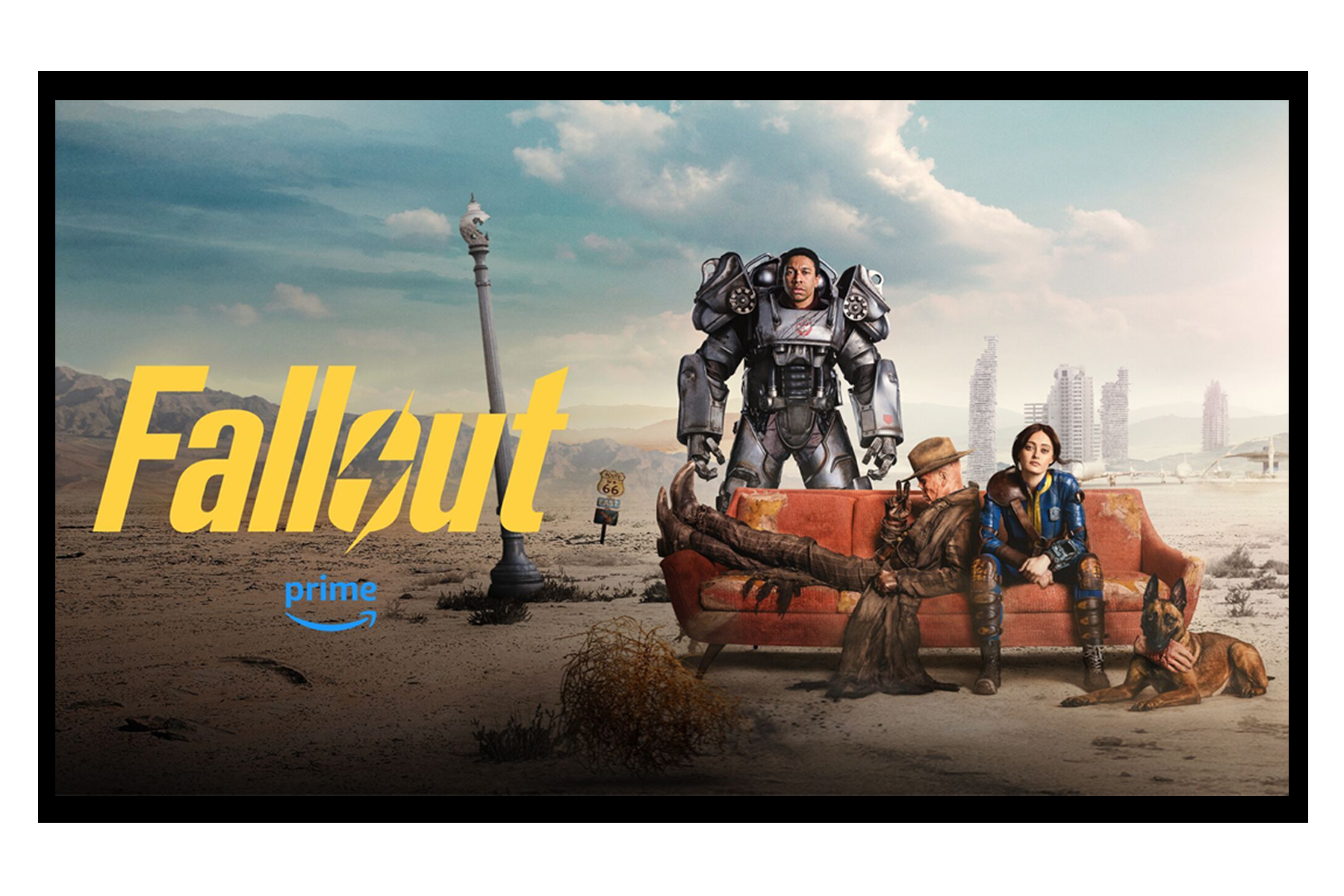
Season 1 masterfully introduced us to this chaos through three distinct perspectives. First, we meet Lucy MacLean (Ella Purnell), a naive Vault Dweller thrust into the brutal surface world to save her father, Hank MacLean (Kyle MacLachlan). Her journey is juxtaposed with Maximus (Aaron Moten), a conflicted squire in the Brotherhood of Steel and The Ghoul (Walton Goggins), a cynical, immortal bounty hunter who remembers the world and the person he was — Cooper Howard — before the bombs fell. The production design is staggering, bringing Power Armour and mutated creatures to life with a tactile grit that feels earned.
However, the show’s true strength lies in how it connects its fictional future to our real-world present. In 2026, we find ourselves grappling with the rapid ascent of artificial intelligence, the monopolization of digital spaces and a widening wealth gap. Fallout leans into these themes with a sharp, satirical edge. Vault-Tec isn’t just a fictional villain; it is a chilling stand-in for the “Big Tech” conglomerates of today — corporations that prioritize shareholder profits over human survival and treat personal data (or in the show’s case, literal DNA) as a commodity. When we watch the pre-war flashbacks of Cooper Howard, we see a society blinded by consumerism and “company loyalty” even as the mushroom clouds loom on the horizon. This feels uncomfortably familiar.
The series also explores the loss of truth in a polarized world. Much like our current era of “deepfakes” and algorithmic echo chambers, the characters in Fallout struggle to find a moral North Star. Lucy begins the series believing in the inherent goodness of vault “Management,” only to realize that her idyllic life was built on a foundation of lies and exploitation. It is a poignant metaphor for the disillusionment that many young people feel today when faced with the systemic failures of modern institutions.
Going into Season 2, the stakes have never been higher. The first season concluded with a silhouette that sent shockwaves through the fanbase: the skyline of New Vegas.
The recently concluded second season only heightened these stakes, successfully transitioning the narrative from the California wastes to the neon-drenched ruins of the Mojave. This season brought the legendary Mr. House (Justin Theroux) to the forefront, the enigmatic overlord of New Vegas who truly embodies the “Silicon Valley” archetype: a man who believes he is the only one smart enough to save humanity, provided he is the one in total control. As Lucy and The Ghoul navigated the treacherous politics of New Vegas, the show leaned further into its critique of institutional decay. We saw the New California Republic struggling to maintain its democratic ideals against the brutal efficiency of Caesar’s Legion — a conflict that mirrors our own modern debates about the fragility of democracy in the face of rising authoritarianism.
By introducing iconic creatures like the Deathclaw and delving into the “Bud’s Buds” conspiracy within Vault 31, Season 2 proved that it wasn’t afraid to get weirder and darker. The discovery that Hank MacLean was essentially a corporate middleman for the end of the world added a layer of personal betrayal that resonated deeply. It forces us to ask: what happens when the “House” — the established powers that be — is revealed to be the very thing that broke the world in the first place? In a reality where the game is rigged before you even step into the casino, the series emphasizes the same grim, recurring truth: “The house always wins.”
Whether it’s the Machiavellian schemes of Vault-Tec or the cold bureaucracy of the Brotherhood, the “House” constantly rigs the game against the individual. Season 2 explored this power vacuum with precision, showing how Lucy and her allies must find a way to navigate a system where every win seems to come at a terrible moral cost.
Fallout forces us to ask ourselves: if the world ended tomorrow, what parts of humanity would we fight to keep?
Whether you’re a veteran Wastelander or a curious newcomer, this series is essential viewing. Just remember that as you navigate the wasteland of the modern world or the ruins of the Mojave, the game might be rigged, but it’s still worth playing.