

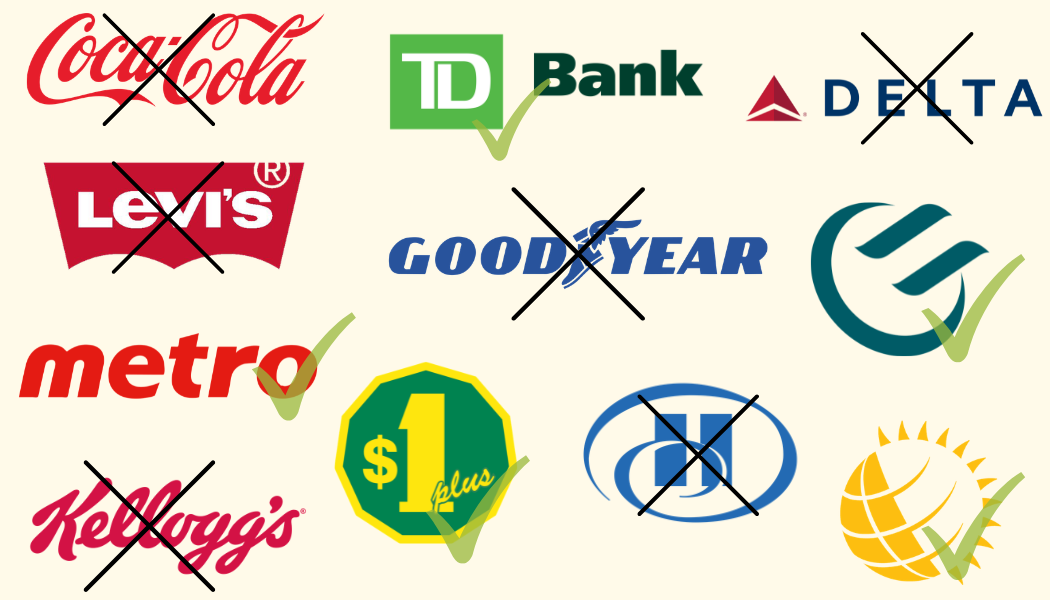
We need to seriously assess what companies we buy from as Canadian consumers, especially considering the ongoing tariff war with the United States.
I recently wrote an article about the current state of the Canada-U.S. tariff war, and I can’t help but reflect on everything President Donald Trump has done (and said) to our country since he was re-elected in 2024.
I remember when he proposed that Canada should become the 51st state in late 2024, to then enforcing unexpected tariffs in early 2025, which was the jump start to severing a longtime trade relationship.
Did he enforce these tariffs because Canadians universally rejected his pitch to become the 51st state? Who knows.
Now, he is suddenly renaming Lake Ontario to Lake America. And to be honest, when I first heard about this, I thought it was an A.I. video or some other form of false information that you see on social media.
But no, this was in fact true and can go on the list of bizarre and offensive things that the President has done that in no way benefit himself and the United States’ citizens.
I mean, has he seen where Lake Ontario is on a map? Can’t he see that although it borders Canada and the U.S., the majority of the lake’s surface area is in Canada? And why would he do this in the first place? To show the reality of his power of renaming whatever he wants? Or maybe he just wants to make us feel threatened.
The name “Lake Ontario” is derived from the Indigenous Iroquoian word “oniatarií,” which translates to “lake of shining waters.” While other translations include “beautiful lake” or “great lake,” the point is that stripping Lake Ontario of its original name also strips away the Indigenous recognition attached to it.
Plus, the word “America” is named after some Italian explorer, which honestly has no connection to the lake itself. Renaming Lake Ontario to “Lake America” would take away something rooted in Indigenous history, which has been done too many times in the past. For Canada, and the United States, recognizing Indigenous history is important, which is why that name matters.
I will be frank and share that I did laugh with my peers about this sudden decision, but now, after keeping up with the ongoing tariff war and seeing where the president’s attention is right now, maybe we should be more alert than we think.
I don’t usually speculate, and I don’t think a full-blown war will happen anytime soon, but right now, Trump’s attention is back on Canada, and he’s done nothing but threaten our economy and make these decisions to try and scare us.
As a Canadian, I agree wholeheartedly with Prime Minister Mark Carney’s matching of the tariff’s “dollar for dollar” even if that means we as consumers pay part of the price.
Since this decision, the President hasn’t done much to mask his irritation to our retaliation, but at what point will he get so annoyed that he stops threatening our economy and escalates this further, giving us something to really feel threatened about.
In 2026, the U.S. will be ranked first out of 145 countries considered for the annual GFP review. This means they continue to be a leader on the global stage in terms of weaponry and fighting power. They are located right next to us, and right now our relationship isn’t looking too great.
Despite my anxiety, a military war remains incredibly unrealistic. But given the President’s quick decisions and constant changes, along with the fact that he still has two more years (and God, hopefully no more) in office, I don’t see our financial conflict with the U.S. ending anytime soon.
I look to myself as a consumer, and I wonder what I can do in the grand scheme of things. I can’t raise the tariffs; I can’t make the big decisions. So, what can I do to fight back against the U.S. in a way that might be effective to what is actually going on?
I believe what all Canadians should be considering right now are the companies we are investing in every day and how they benefit the U.S. economy. If the President wants to sever ties with Canadian companies, why should we continue contributing to the U.S. economy?
Now, I am not saying Canadians should completely cut themselves off from every U.S. company. That would be nearly impossible. But there are everyday purchases we make at U.S. stores that we could transition to Canadian alternatives.
Instead of buying from Walmart (where their net profits end up in the hands of U.S. executives and shareholders), Canadians should try and shop at Giant Tiger (a Canadian discount retail chain that sells similar products). Instead of McDonald’s, we should consider A&W or Harvey’s, both fully Canadian fast-food operations.
And come on, Tim Hortons can replace Starbucks any day of the week and twice on Sundays. I’ve been to both, and Tim Hortons is cheaper, so why not give it a try?
To find more examples of Canadian company replacements, an article by Global News shares more alternatives.
None of these choices are going to single-handedly change the tariff war. I know that. One person choosing to eat a Harvey’s burger over a Big Mac is not going to make Trump wake up tomorrow and suddenly leave us alone.
But collectively, our spending has power.
Canadian consumers have already shown that they are willing to change their buying habits. A 2026 Angus Reid survey found that 40 per cent of Canadian grocery shoppers were checking where products came from, while the broader “Buy Canadian” movement has continued to grow.
It’s evident that the tariff war is ongoing, and I don’t think the President will stop anytime soon. And in reality, I believe we will slowly be dealing with the financial consequences for a while.
But I think that right now we should be okay with that. Collectively, we need to consider where our money goes and deciding that, when we have the choice, we would rather keep it here.
Of course, it won’t be perfect. I mean, Microsoft is not a Canadian company, and our university relies heavily on it every single day. We can’t realistically avoid every U.S. company, nor should we feel guilty over every non-Canadian purchase we make. But when we have a choice; I think it is worth asking ourselves where our money is going.
If Canadians are going to feel the effects of this tariff war anyway, we might as well make our spending count. We may not be able to control what Trump does, but we can control where some of our money goes — and right now, keeping it in Canada seems like a pretty good place to start.