

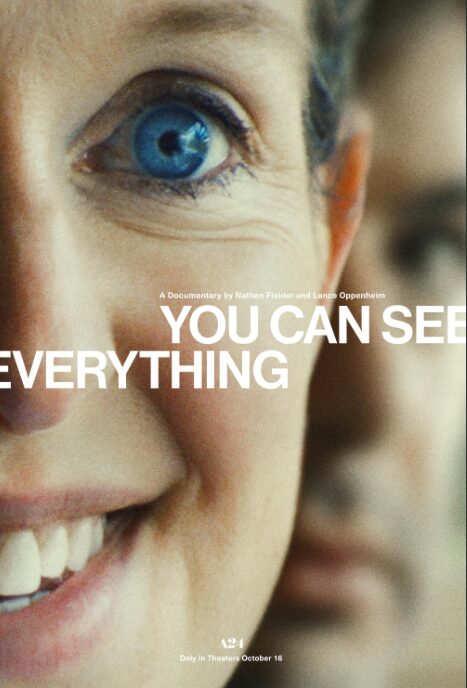
If you are familiar with Nathan Fielder, you’re familiar with the absurdity that usually defines his comedic style. His deadpan humour paired with flamboyant characters and increasingly ridiculous situations often makes for some of the most uniquely uncomfortable and hilarious television.
His newest film, You Can See Everything, is a documentary centred around renowned fraudster Elizabeth Holmes. But in true Nathan Fielder fashion, that description is too simply put. What instead arrives on screen is something much stranger, yet incredibly brilliant.
Around 2014, a Stanford student named Elizabeth Holmes started taking the world by storm through various avenues. Holmes infiltrated the tech world, embodying the dreams of biotechnology, finance and feminism as the founder of Theranos.
Her company, Theranos, declared that they had created a small and accessible blood testing device that was more affordable around the world, and would save lives in turn. Theranos claimed that their technology could measure cholesterol, diabetes and test for cancer.
At its peak, the company amassed a net worth of $9 billion, making Holmes the youngest female billionaire, with features in the media and on the covers of Time Magazine and Forbes.
But the technology never actually worked.
In 2022, Holmes was found guilty of fraud and sentenced to 11 years and three months in federal prison.
Before carrying out this sentence, Nathan Fielder lived with Holmes, her husband and their two young kids for 34 days. This is where the documentary begins, but it certainly isn’t how it ends.
During the first hour of the three-hour film, the audience is placed intimately and awkwardly within the confines of a rented beach house shared by Fielder and Holmes’ family. We are immediately connected to Fielder, who occupies the same space as Holmes and her family, surrounded by cameras and recording equipment that capture them in their most vulnerable moments.
He awkwardly inserts himself into intimate situations, creaking floorboards and apologizing for his presence — a fly on the wall, buzzing in their ears.
In recent years, Fielder has seemed to hone his skills in creating environments of suspenseful unease. The Curse and The Rehearsal seemed to be stepping stones for his most indulgent exploration of this through You Can See Everything.
Elizabeth Holmes and her husband, Billy, spend most of the film trying to convince the audience of her innocence, with piercing blue eyes and a suspicious, manufactured sincerity. At one point, Fielder tells her that her life has been built around this fraud, and people’s perception of her has been based on this for so long that no matter what she says, they’ll never believe her innocence.
I can’t remember her response, and I won’t try to guess, as this is much of what Fielder struggles with throughout the film. Our memory can be misleading, and Fielder makes clear just how dangerous this can be.
While that first third of the movie is filled with documented first-hand accounts from Holmes, the two remaining thirds are fuelled by the memories of other people. While I don’t believe in Holmes’ innocence, she does a great job of making me want to, and she clearly had a similar effect on Fielder.
The last two hours and much of the film are not seen in the trailer, and it’s best not to tell you how it unfolds now. While you could read about it here, the theatre allows you to experience the same shocks and disbelief as everyone else around you is bound to feel. In true Nathan Fielder fashion, he explores the world and culture surrounding Holmes with a meta lens, and the bizarre nature of what transpires in the rest of the film must be experienced directly.
Fielder manipulates our malleable memory throughout the film, gradually making it difficult to distinguish between what actually happened, what people remember happening and what Holmes wants us to believe happened.
By the end, even your own understanding of Elizabeth Holmes begins to feel unreliable, and whether Fielder has successfully exposed something about the nature of truth or simply left us questioning everything is difficult to say.