

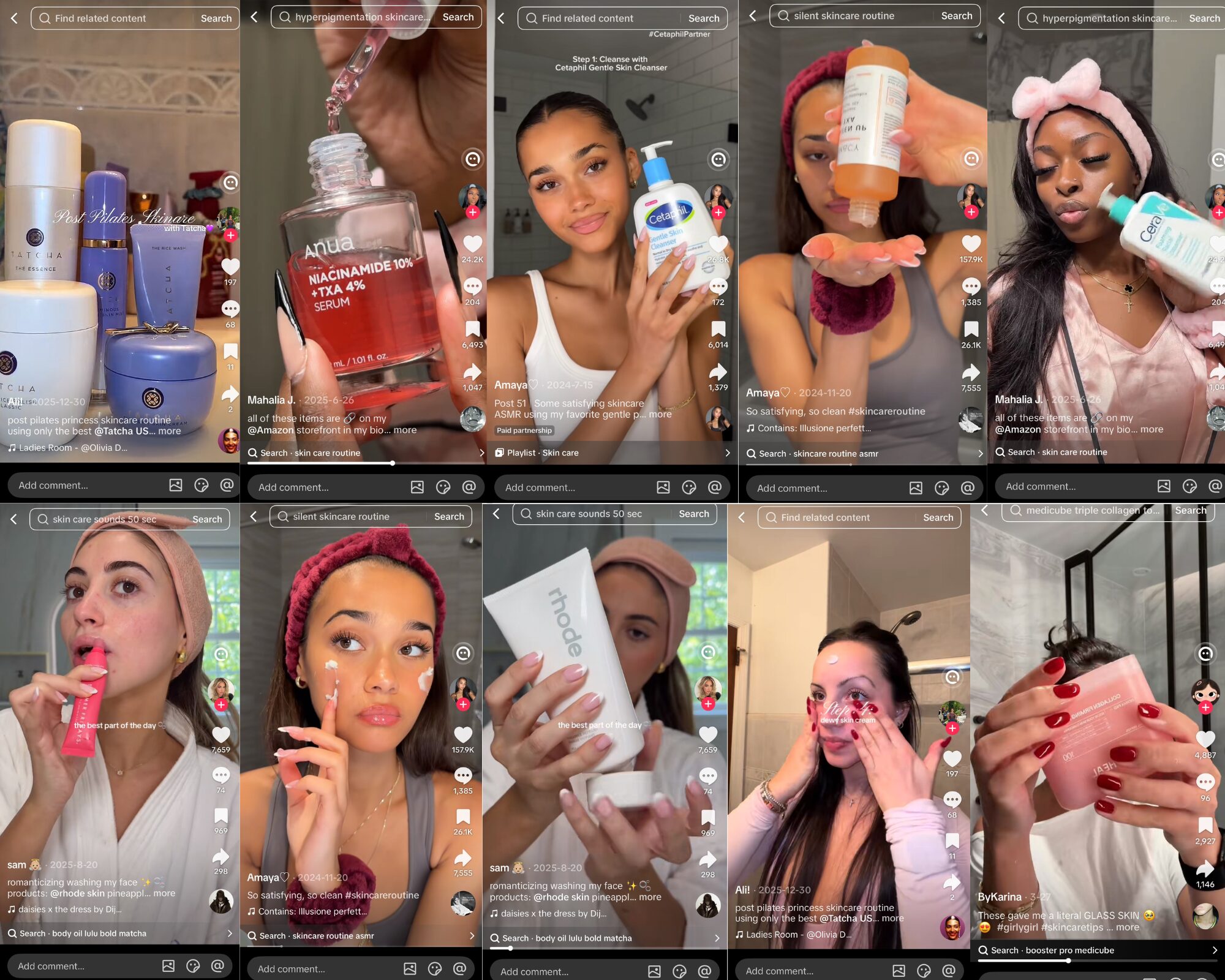
The influx of online content focused on “wellness” endeavours — such as physical fitness routines, developing anti-aging regimens and pushing supposed health-improving products — is not only indicative of the ever-growing relationship between social media and consumerism; it also demonstrates the relationship between social media, consumption and our cultural shift to the right.
Over the past few years, the wellness industry has had explosive gains thanks to short-form content platforms like Instagram and TikTok. According to consumer research from Capital One, TikTok Shop, the in-app shopping feature piloted in American versions of the TikTok app, made $15.82 billion in sales during 2025. A massive 81 per cent of these sales were on health and beauty products.
Whether it be from the rise of deceptive product placements within beauty influencers’ content or the increasingly shorter trend cycles pushed online, it seems that the beauty industry will continue to be endlessly profitable so long as short-form content reigns as a central source of entertainment.
Though it is obvious that the beauty industry has remained successful by manufacturing insecurities for the purpose of selling products to “fix” said insecurities, the popularity of wellness content cannot be blamed solely on the beauty industry’s profit motives.
In fact, wellness content could not be so successful if not for our increasing cultural shift to the right. The shift to an obsession with all things health and wellness comes in tandem with an influx of content littered with conservative dog whistles and gestures toward purity culture.
Take, for example, the countless TikTok videos urging young people to reconsider their alcohol consumption.
Though it is perfectly valid to warn young people about the dangers of substance abuse and the importance of moderation, most wellness influencers don’t situate their problems with alcohol within issues of addictiveness or capacity for overuse.
Instead, they take issue with how alcohol can impact your health goals — or, more accurately, your weight.
Alyssa Koser, a TikTok fitness influencer, exemplified this messaging perfectly when giving advice on how to “have a crazy good physique”:
“You would have a wildly better physique if you stopped fucking drinking every weekend, if you had some discipline. […] It’s inherently true. It’s wasted calories. It’s fucking up your sleep; your recovery; your metabolism, for days; your protein synthesis, for days; and the quality of your lifts. It’s also making you inflamed, and it is liquid cancer.”
In the caption of the video, Koser elaborated:
“Unfortunately, alcohol is the worst thing you can do for your gains. […] Learn to have some fun outside sober (more often). Watch how quickly you slim down when you stop drinking so much.”
Again, to be clear, there is a difference between encouraging sobriety for its physical benefits — especially regarding instances of substance abuse — and shaming young people for drinking because it interrupts their assumed pursuit of thinness.
It is interesting how, despite being a fitness influencer, Koser focuses on the relationship between drinking and one’s weight. Though it is more than obvious that someone’s weight is not necessarily an indicator of their health, many videos sharing similar sentiments to Koser’s also equate wellness to thinness, and thinness to superiority.
It is pretty much common knowledge at this point that decade-old messaging situating thinness as a chief beauty ideal — especially for women — has done far more harm than good.
But the association between thinness and beauty is not a natural impulse; in fact, we’ve seen countless different iterations of beauty standards across history and culture. The association between thinness and beauty is purely patriarchal. And, as we know, patriarchal notions of womanhood are deeply engrained in conservative messaging.
On the relationship between thinness and patriarchal notions of beauty, Sara Matsigner of the Women’s Media Center argues that messaging urging us all to endlessly trudge towards thinness is not actually about the pursuit of beauty.
It’s about keeping women under constant control.
On the political dimensions of pursuing thinness, Matsinger writes the following:
“Constantly thinking about food and your body takes up a lot of mental space. Counting calories, watching the clock to see when you are ‘allowed’ to eat again, planning how to go to a birthday party and avoid eating a slice of cake — all of that uses mental capacity. That is a mental capacity that could have been used for creativity, ambition, or just living freely.
“A friend once told me, ‘A woman who counts her almonds can never become president.’ That line has stayed with me. Not because it is literally true, but because of what it captures. When so much of your attention is directed toward shrinking your body, there is less space to look outward, to question systems, to lead, to imagine something bigger.”
It is crucial to keep in mind that, even though short-form content can often feel informal or unserious, there are often political implications in most messaging pushed online. Next time you feel the inclination to internalize the health advice you see on TikTok or feel the shame that comes with skipping out on the latest fitness trend, remember that not all online discourses function in your best interest.