

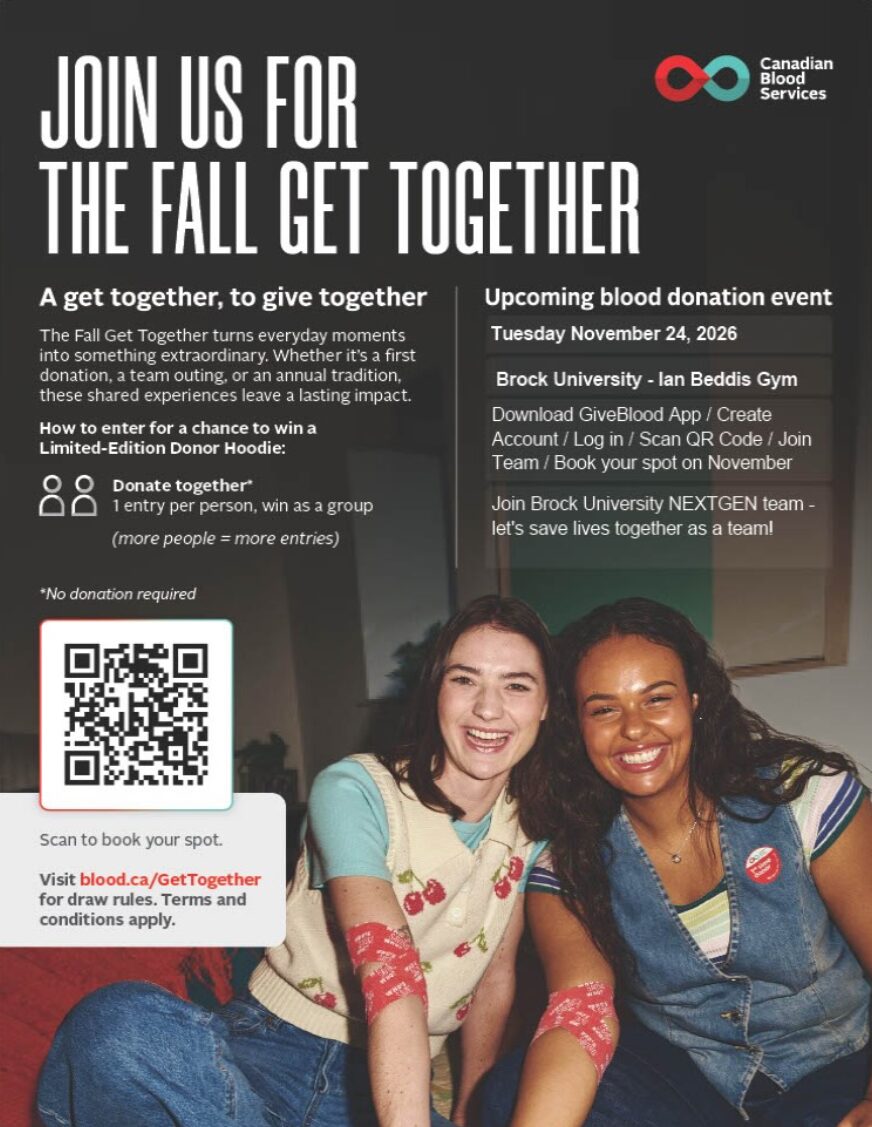
Brock University’s upcoming blood donation clinic is looking to recruit 135 donors as Canadian Blood Services (CBS) encourages faculty, staff and students to help contribute to the country’s blood supply.
The clinic, organized at Brock by NextGen, will take place on Tuesday, Nov. 24, from 10 a.m. to 4 p.m. in the Ian Beddis Gymnasium.
Students interested in donating can book an appointment through the Canadian Blood Services website or on the GiveBlood app. First-time donors must be at least 17 years old and in good health, while also weighing at least 110 pounds. Those between 17 and 23 who have never donated before must meet additional height and weight requirements.
On the day of the appointment, donors must bring one piece of government-issued identification that displays their full name and date of birth and complete a questionnaire that will be provided 24 hours beforehand.
Students can also participate in CBS’s Fall Get Together campaign, where they can enter a draw to win a “limited-edition donor hoodie” valued at $139, created in collaboration with Peace Collective. To enter, donors must book and attend an appointment on the same day as at least one other person. Each must register for their own appointment and then scan a QR code at the clinic to submit an entry.
Participants do not need to make a donation to enter the draw, although they must meet the campaign’s appointment and group requirements. The campaign runs until Dec. 6.
According to CBS, one in two Canadians are eligible to donate blood, yet only one in 76 does.
Lilet Raffinan, Business Development Manager at Canadian Blood Services, said in an interview with The Brock Press that regular donations are even more important now, as many regular donors are becoming too old to donate.
“Every 60 seconds, someone, somewhere in Canada needs blood. One whole blood donation can help three lives,” Raffinan said. “That’s why it’s very important.”
Blood donations support patients undergoing major surgeries, medical procedures and cancer treatments. In a CBS article posted in 2024, CBS explained that donated blood and plasma can also help patients with conditions such as sickle cell disease, organ failure and immune disorders.
Raffinan adds that post-secondary institutions have an important role to play in encouraging younger generations to become regular donors, rather than waiting until an urgent need arises.
She shared that CBS needs 135 spots booked in the Nov. 24 clinic. At the time of the interview, only about 90 appointments were filled.
“When people actually hear about it, they do sign up, but if we don’t promote it, then the tendency is [for] nobody [to] sign up,” Raffinan said.
Before attending the clinic date, Raffinan recommends that students prepare throughout the week before an appointment by eating well, drinking plenty of water and avoiding caffeinated drinks on the day of their appointment.
For students who fear needles or uncertain about the process, Raffinan encourages them to bring a friend for support, volunteer for CBS or join the BrockU Blood Services Club.
The BrockU Blood Services Club is responsible for organizing and promoting the blood donation clinics at Brock. The student initiative encourages younger people to become involved with blood services and helps increase awareness about the importance of donating.
In an interview with The Brock Press, Gideon Joubert, a fourth-year biomedical sciences student at Brock and co-chair for NextGen, said people interested in getting involved do not necessarily have to donate blood themselves to support the initiative.
“We have a good younger base who are actually very engaged in wanting to help,” said Gideon. “Anybody who’s interested in helping with blood services at all or is interested in kind of being involved with blood donation, [if] they think it is important, they should absolutely join the NextGen team, [they can] reach out to either me or someone else.”
Students who cannot donate can still contribute by volunteering with NextGen, promoting upcoming clinics and encouraging eligible friends and family members to register for clinics. Those who are not eligible for whole blood donations may also be able to donate plasma through the St. Catharines CBS donor centre, depending on whether they meet the requirements.
For Raffinan, the importance of the clinics extends beyond the university, offering students an opportunity to make a difference in Canadian lives.
“[For] Brock students [who want] to do something for the community, this is an opportunity for them to do something that really makes an impact [on] the lives of many patients,” she said. “You never know whose life you’re going to save next.”