

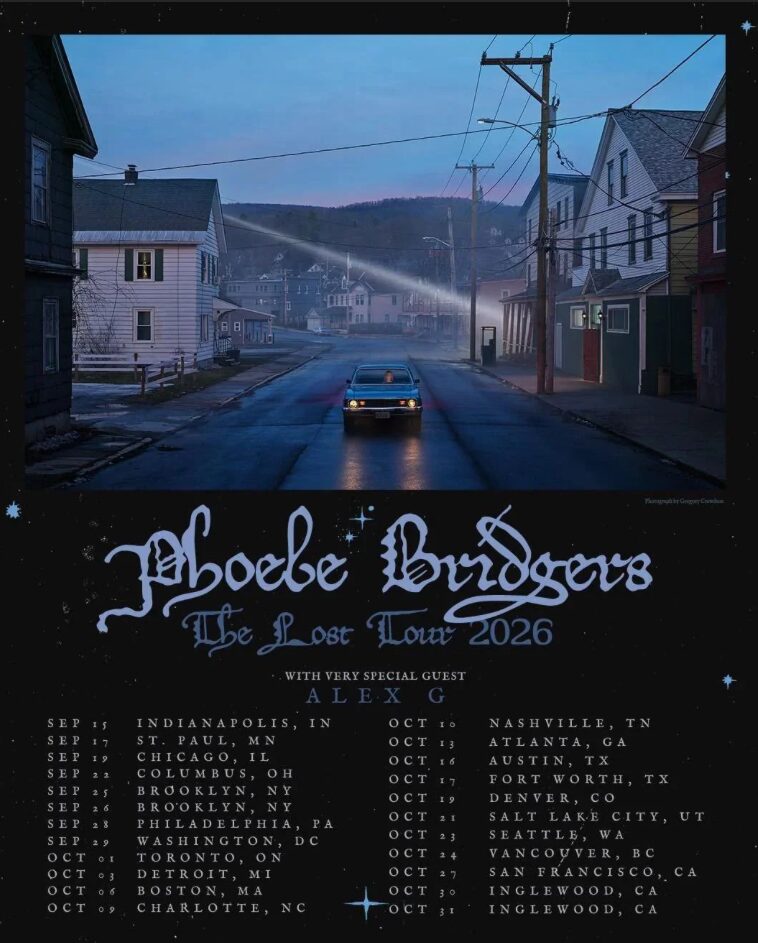
On Thursday, Oct. 1, Phoebe Bridgers played the first of two sold-out nights in Toronto as part of her Lost Tour, with Alex G as the opening act. The tour follows the release of Bridgers’ third LP Lost Weekend, which explores the recent and unexpected loss of her father and all the feelings that came with it.
While I can always justify cheap concerts at smaller venues, I didn’t know what to expect from my favourite indie artist in a huge stadium. But bigger venues provide the opportunity for artists to invest more in their production, and the live show brought the album’s grief to life, making for a harrowing yet incredible concert experience.
Upon walking into the arena and getting through the security line, there was an additional pre-concert ritual to endure: locking your phone away. For this tour, Bridgers enforced a no-phone policy, where guests place their phones in small, locked pouches for the night. Guests can keep this pouch in their bag or on their body with the attached lanyard, with the option to use their phones in a specific area where employees can unlock it, then lock it again when they leave.
Inside the venue, there were lines wrapped around the arena for merchandise. There was a separate line for a photo booth, where fans could take photos with the date and name of the tour at the bottom.
Walking into the arena, there were two stages: one main stage at the back and a small circular stage on the opposite side. On the smaller stage, Alex G began his set with songs spanning his discography, mainly pulling from his newest album, Headlights.
Both Alex G and his band commanded the space, even while occupying such a small portion of the room. Particularly on the track “Headlights,” they allow the instrumental to extend far beyond the recorded version.
Alex G played for about an hour, with Bridgers following around 9 p.m. She opened with the first track on Lost Weekend, “The Outside.” The track is — as most of Bridgers’ music is — incredibly haunting, using a vocoder to sound robotic and dissociated from the experiences she sings about. Throughout the song, the audience could not see her, as it was too dark and there were only sudden bursts of light for spectators to make out what was going on.
This led into the second song, “Motion Sickness” — from her first album Stranger in the Alps — where the dome-shaped main stage opened to reveal Bridgers and her band.
She was wearing a black dress with tears of glitter running down her face. The crowd was screaming and singing back at her as loudly as they could, and the girls standing on either side of me burst into tears.
This dome shape was constantly used as a prop throughout the concert. While sometimes used to cover the band as they moved from the big stage to the smaller one, it was also lifted in various ways. During the first song, it was raised up to act as a sort of spaceship. But later, the dome turned to a 90-degree angle and showed projections of Bridgers and images of the moon, most notably during “Moon Song.”
The lights and set design were integral to the show’s impact and to telling the story of her grief, isolation, loneliness and how that manifests. While beginning on the main stage, she moved to the smaller stage to play “Lost Weekend.” She was by herself on the stage; it was dark, the band was gone and it felt like we, the audience, were not there either, like she was completely alone.
But through these moments, instead of seeing phones recording in the crowd, you saw lighters held up high and a few glow sticks too. There was a presence to the audience and a connection to being with her in that moment that felt intentional, not to be disrupted by a phone.
She continued to play alone on the small stage for a few songs. Then, she paused and talked about her father’s passing. She got vulnerable with the audience, telling us that when her father was alive, they had a complicated relationship, in which she had to constantly set boundaries. Bridgers said that when he died, she could finally empathize with him without all the shortcomings he had when he was alive.
She chuckled a little and said that’s what the album’s about, asking if anyone else had a dead dad in the room. There were scattered cheers throughout the crowd, to which Bridgers responded by sharing how much closer she feels to this community of people who have experienced the same thing. She began to play “Still Standing,” a song about her father.
Bridgers made her way back to the main stage and eventually sang “I Can’t Wait.” On the album, this song features Cameron Winter, but at this show, her brother came out quickly to sing Winter’s lines with her. It felt very intimate, hearing two siblings harmonize with each other after Bridgers had just talked about the passing of their father.
At the end, fans cheered for an encore and Bridgers eventually came back to the small stage as her band played on the main stage. This time, she was wearing a white dress, and the tears on her face were thicker than before. She played “Lost Weekend (Reprise),” then “Scott Street.” To close, her band played the crowd and Bridgers out with the song “Never going back!,” marking a bittersweet end to the show.
When it was over, employees stood at the exit, unlocking phones from pouches. I wanted to write everything down right away so I didn’t forget it, as I felt that my memories of the show already weren’t perfect, and I wanted to remember everything exactly as it was.
I don’t know if this was Phoebe Bridgers’ intention when she decided on her “no-phone” rule, but I think watching her on stage connect to her grief while also connecting to thousands of people in the crowd could only be captured in that moment. As much as I’d like to remember every detail, I can’t. The show encourages you to hold onto the memory you create, however fleeting and unreliable.