

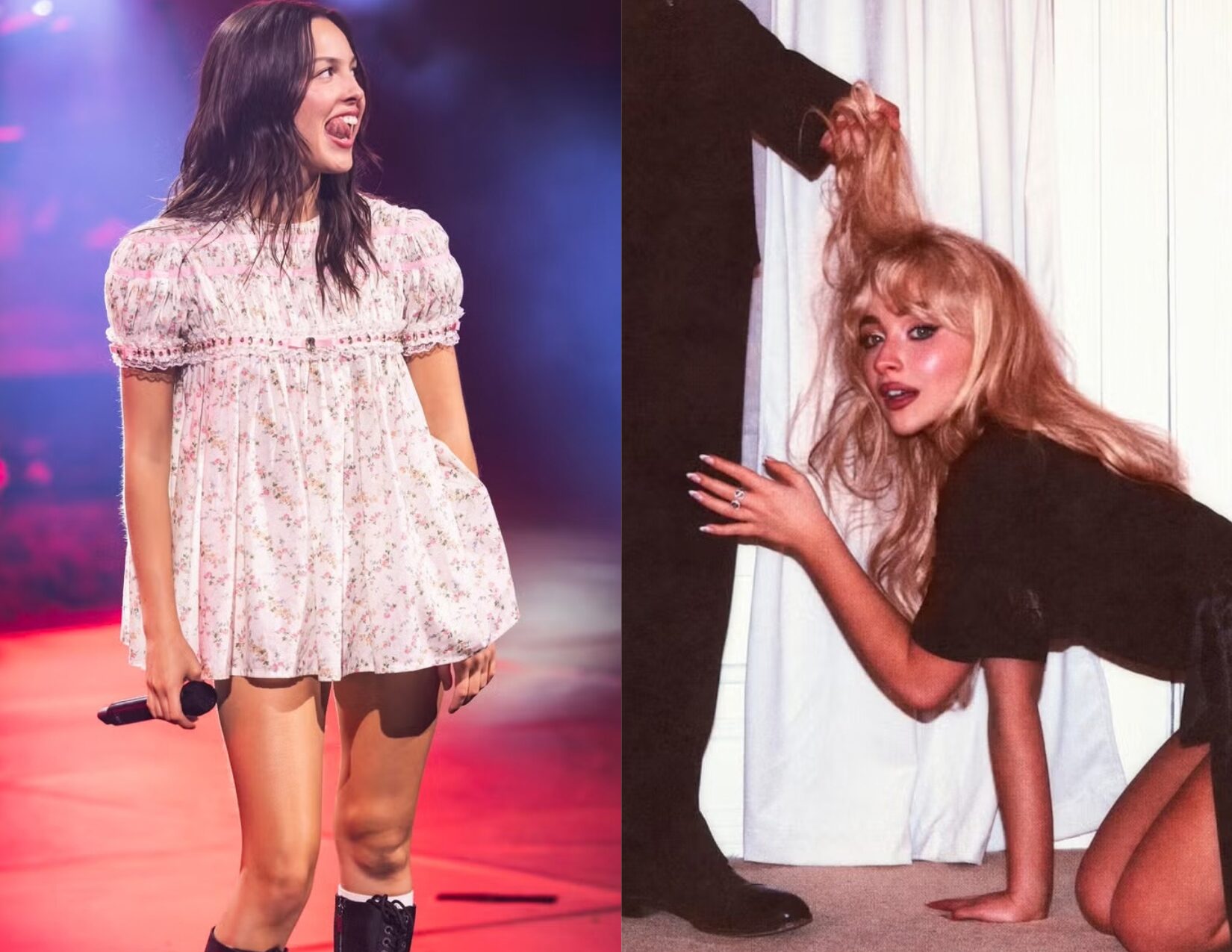
How is it that Sabrina Carpenter is too sexual, and the new era of Olivia Rodrigo is not sexual enough?
When Carpenter unveiled the cover of her 2025 album Man’s Best Friend, which depicts the singer on her hands and knees while an anonymous male figure grips a fistful of her hair, criticism immediately followed. The image was accused of glorifying female submission, reinforcing misogynistic sexual imagery and perpetuating the harsh realities of the sexual abuse women face instead of confronting them. Glasgow Women’s Aid was among those criticizing the imagery as “regressive,” while defenders argued that Carpenter’s highly exaggerated pop persona made the cover less an endorsement of submission than a deliberate joke about it.
A year later, Olivia Rodrigo faced almost the opposite controversy.
The release of her “Drop Dead” music video where she appears in a pastel babydoll-styled outfit, paired with her wearing a floral babydoll dress during a May 2026 performance in Barcelona, online moral panic was ablaze, accusing the 23-year-old singer of infantilizing herself and appealing to the male gaze through an aesthetic they labeled “pedo-core.” Rodrigo responded that she had previously performed in considerably more revealing outfits without inspiring the same accusations. To her, blaming a woman for wearing something because a man might sexualize it merely reproduces the rhetoric girls hear from childhood: do not wear that, because a man might respond to your body, and his response will somehow become your responsibility.
Placed beside one another, these controversies expose a peculiar trap.
A woman can apparently cater to the male gaze by making herself overtly sexual, as Carpenter is accused of doing, and she can simultaneously cater to it by wearing something comparatively modest if observers decide that the clothing evokes innocence in a way that may be fetishized.
At some point, we must ask whether we are still criticizing the male gaze or simply gazing at women through it.
The phrase was introduced by art-critic John Berger in his 1972 book Ways of Seeing, and later fully developed by film theorist Laura Mulvey in her 1975 essay “Visual Pleasure and Narrative Cinema.” John Berger famously observed that women learn not only to exist but to watch themselves existing, to imagine how they appear to an observer. Mulvey furthered this argument by looking into how conventional cinema organized looking: the camera, audience and narrative frequently positioned men as active spectators while women appeared as objects of visual pleasure. Women were not simply attractive; cinematic language made their “to-be-looked-at-ness” central to their role.
The “male gaze” was never supposed to mean “something heterosexual men might find attractive.” Yet online, the term increasingly functions exactly this way. A female celebrity wears something sexy, performs sexuality or embraces conventional femininity, and the question immediately becomes whether she is doing so “for men.”
Carpenter is admittedly the harder case.
The Man’s Best Friend cover deliberately deploys imagery associated with female submission. Carpenter kneels beneath a standing man whose face is absent from the image; his hand is tangled in her hair. It would be reductive to pretend those visual choices carry no cultural meaning. Feminist criticism should be able to question why images of female submission remain marketable and whether reproducing patriarchal sexual fantasies can reinforce them, even when the woman participating does so willingly.
But recognizing an image’s cultural history is different from assuming its meaning is singular.
Carpenter has built much of her recent artistic persona through exaggeration. Her performances combine pin-up aesthetics, absurd sexual innuendo, theatrical femininity and jokes about heterosexual relationships that are frequently at men’s expense — one of the most notable examples being her song “man-child.” Her public image repeatedly plays with the archetype of the submissive blonde bombshell while simultaneously making that archetype ridiculous.
None of this automatically makes the image feminist. But neither does using a patriarchal visual language necessarily mean surrendering to it.
Satire, parody, camp and sexual fantasy all depend on our ability to distinguish representation from endorsement. If every depiction of female submission is inherently an endorsement of women’s submission, there is little room left for women to play with the symbols that have historically been imposed upon them.
Still, “she chose it” cannot be where the analysis ends.
Women do not make aesthetic choices outside culture. Female pop stars operate within an industry that rewards youth, beauty, sexuality and particular forms of femininity. Choices can be voluntary while being shaped by social expectations and commercial incentives. Feminism should absolutely remain capable of asking why certain images are rewarded and what cultural assumptions make them legible.
But there is an equally troubling opposite conclusion because patriarchy influences women’s preferences, women who choose conventional femininity or sexuality cannot really be exercising agency at all.
Follow that logic far enough and feminist criticism becomes paternalistic. A woman may believe she likes miniskirts, lipstick, lingerie or flirting, but someone else can always inform her that she only thinks she likes those things because patriarchy has conditioned her to. Thus, she can be liberated from everyone’s interpretation of her desires except the “feminist” critics.
Rodrigo’s babydoll controversy reveals this problem particularly clearly.
Babydoll dresses have cultural histories far beyond infantilization. In the 1990s, musicians including Courtney Love and Kat Bjelland helped popularize a deliberately contradictory aesthetic that paired girlish dresses, bows and other symbols of conventional innocence with smeared makeup, aggressive music and confrontational performances. The collision between femininity and rage was precisely the point. Rodrigo cited figures including Love and Kathleen Hanna when discussing the inspirations behind her own styling.
Yet online criticism often bypasses that history completely. The dress looked “childlike”; therefore, an adult woman wearing it was supposedly presenting herself as sexually childlike. But that interpretation has to come from somewhere.
Rodrigo herself highlighted the absurdity: she had appeared onstage in bras and short shorts without generating equivalent outrage, yet suddenly a loose, floral dress became sexually inappropriate because people projected childhood onto its silhouette.
There are certainly contexts in which infantilization can be deliberately eroticized, and criticizing those representations is legitimate. But if the argument is simply that women who wear clothes that men could fetishize are intentionally doing so for men, it places all of the responsibility onto women.
School uniforms, business suits, sundresses and gym clothes, modesty and nudity, heels and bare feet are all heavily fetishized. There is virtually no form of female presentation incapable of becoming someone’s sexual preference. Once “could a creepy man find this attractive?” becomes the standard by which women determine what they are permitted to wear, creepy men acquire extraordinary power over women’s wardrobes.
This is where discourse supposedly criticizing the male gaze can begin reproducing one of its fundamental effects: women are taught to view themselves from the outside. The hypothetical man no longer even needs to be present; his imagined reaction is enough to organize the conversation.
This is also why sexuality and objectification cannot be treated as synonyms. A woman expressing sexuality is a subject possessing sexuality. An objectified woman is reduced to an object primarily existing for another person’s consumption. Those experiences can overlap, but they are not identical.
If a woman dressing in a way heterosexual men enjoy automatically means she is catering to patriarchy, her autonomy and personal preference are no longer considered. Her existence is once again viewed through the eyes of heterosexual men.
Too sexual is regressive. Too innocent is apparently also regressive.
The problem is not that the concept of the male gaze has become useless. On the contrary, it remains valuable precisely because visual culture continues to objectify women. But there is a crucial difference between analyzing how an industry constructs women for consumption and placing responsibility on individual women to prevent themselves from ever being consumed.
The conversation should not be centred around whether female artists like Carpenter and Rodrigo are successfully escaping the male gaze but rather question why women are expected to dress as though managing how men look at them, desire them or project fantasies onto them is their responsibility.