

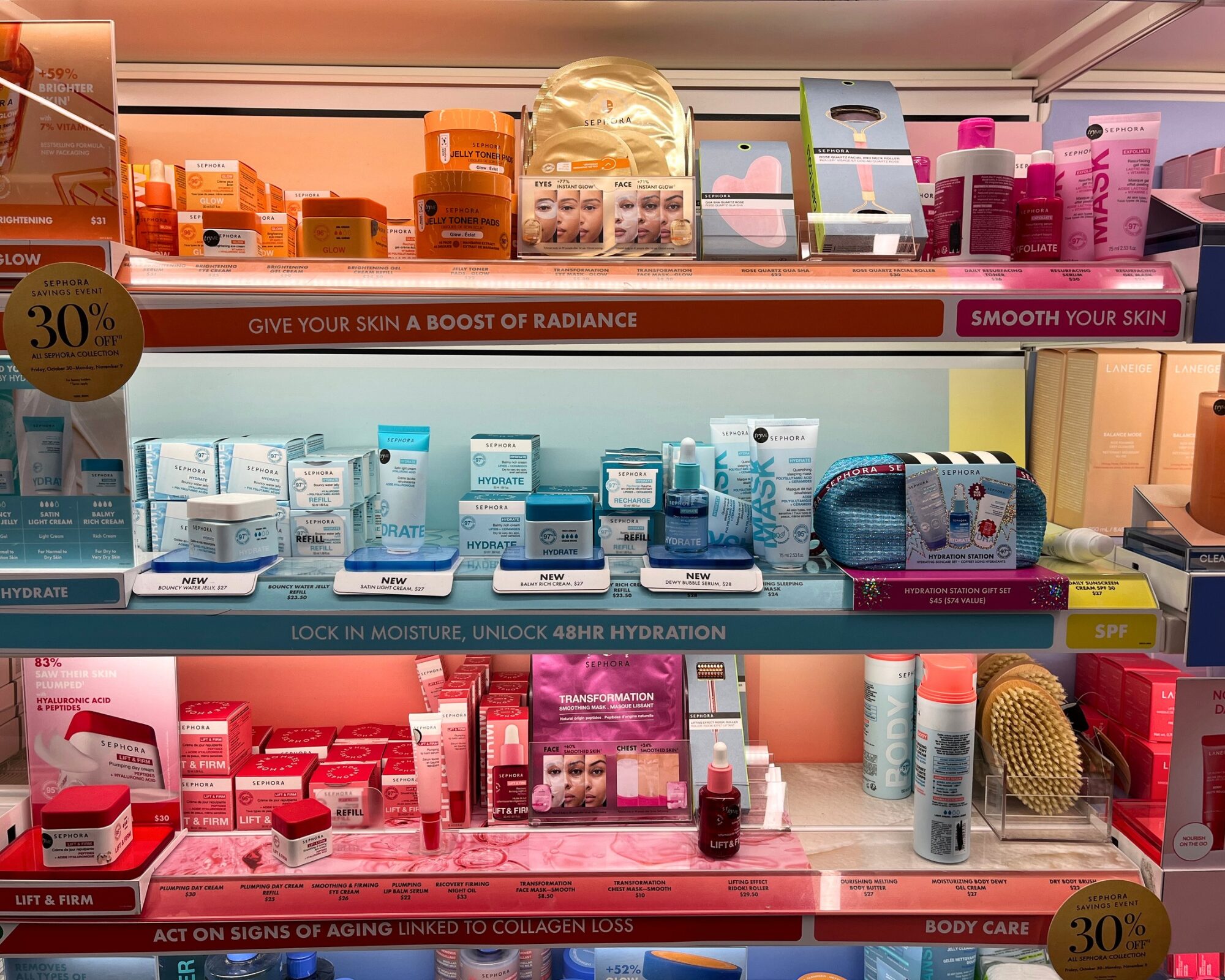
After a long week, I often find myself longing for a fresh manicure, a shopping cart full of luxuriously perfumed body lotions, serum-infused masks that promise to save my face from wrinkles and some overpriced (fake) silk pyjamas. Since when has consumption equated to self-care, and why are extensive beauty routines marketed as a way to relieve your stress?
Throughout my time spent in university, I’ve felt myself increasingly drawn to consumption as an antidote to my stress — and, from what I’ve seen online, I don’t think I am the only one. Whether it is the urge to “reinvent” oneself or a sudden obsession with self-improvement, consumption has long been construed as a means to inject pleasure into our stressful daily lives.
The most elusive example of the intertwining of consumption with wellness is the ever-booming “self-care” industry. Closely aligned with the beauty industry, self-care products are marketed on the basis of their capacity to help you relax, unwind and return to yourself after a long, exhausting day of labour.
The advertising is mostly feminized, often speaking specifically to an upper-middle-class female audience dubbed by Forbes writer Maia Niguel Hoskin as the “modern professional women.” On this ever-growing class, Hoskin writes:
“Modern professional women are one of the most optimized populations in history. They track sleep, hydration, stress, steps, nutrition, productivity, hormones, and mood. They attend therapy, practice mindfulness, invest in skincare, and outsource inconvenience wherever possible.
“At some point in the last decade, exhaustion has become a beauty problem. Dark circles were reframed as skincare issues, stress became inflammation, and being overworked became ‘aging.’ But oddly, the solution for many women has not been rest. Instead, it’s been a serum, a supplement, a meditation app, or red-light therapy; and sometimes, all of the above.”
In her piece “Self-Care Became a Billion-Dollar Industry. Women Are Still Exhausted,” Hoskin picks up on a core issue within the self-care industry: instead of focusing on why we feel so exhausted and depleted at the end of a workday, we’re encouraged to focus on how we can eliminate the evidence of our exhaustion. For women, of course, eliminating exhaustion looks like becoming as youthful, glowing and daintily beautiful as possible — all to keep up with the patriarchal expectations for feminine expression.
It is obvious that the beauty industry is a direct result of patriarchy — we know that wearing makeup or covering our grey roots, for example, are not natural urges but obvious attempts at embodying a type of patriarchal beauty, even if we don’t necessarily agree with the logics behind it. The self-care industry, however, is far more elusive because these practices, such as purchasing expensive skincare or attempting red light therapy, can easily be construed as something done for ourselves and our wellbeing.
In an article for the European Journal of Cultural Studies, British sociologist and feminist cultural theorist Rosalind Gill situates this type of “self-care” rhetoric within the realm of “choice biography.” Choice biography, Gill writes, arises out of the interplay between postfeminist constructions of autonomy and the psychological sensibility neoliberalism expects from us, and can be defined according to “the contemporary injunction to render one’s life knowable and meaningful through a narrative of free choice and autonomy, however constrained one might actually be.”
Gill writes that the construction of feminine maintenance labour as chosen self-care practices relies on neoliberal conceptions of femininity, elaborating:
“Achieving desirability in a heterosexual context is explicitly (re-)presented as something done for yourself, not in order to please a man. In this modernized, neoliberal version of femininity, it is absolutely imperative that one’s sexual and dating practices be presented as freely chosen (however traditional, old-fashioned or inegalitarian they may be — involving strict adherence to rules, rationing oneself and not displaying any needs). […] Some of the strain of this position — the messy suturing of traditional and neoliberal discourses — can be seen very clearly in […] the need to disavow explicitly a potential reading that ‘you’ would be doing this to please a man.”
Though Gill is examining the language of feminine maintenance labour in the “chick lit” genre, her point still rings true in the context of the modern self-care industry.
If beauty routines are constructed as a means to escape the stress of daily life, patriarchal logics have a fool-proof way to keep women constructing their feminine expression around patriarchal desire. Even though it can most definitely feel relaxing to submerge yourself in lotions and end the night with a cold sheet mask promising to bring some collagen back into your tired skin, it is worth considering why women are pushed to spend each evening attempting to stave off aging and trying to become as soft, perfumed and perfect as possible.