

Content warning: this article contains discussions of sexual violence. If you or someone you know is navigating the trauma of sexual violence, information regarding local helplines and support centres can be found on the Ending Sexual Violence Association of Canada’s website.
The horrific sexual violence that is alleged to have taken place at Cornell University was not a fringe crime; it encapsulates the behaviours, beliefs and actions that are normalized and excused within rape culture.
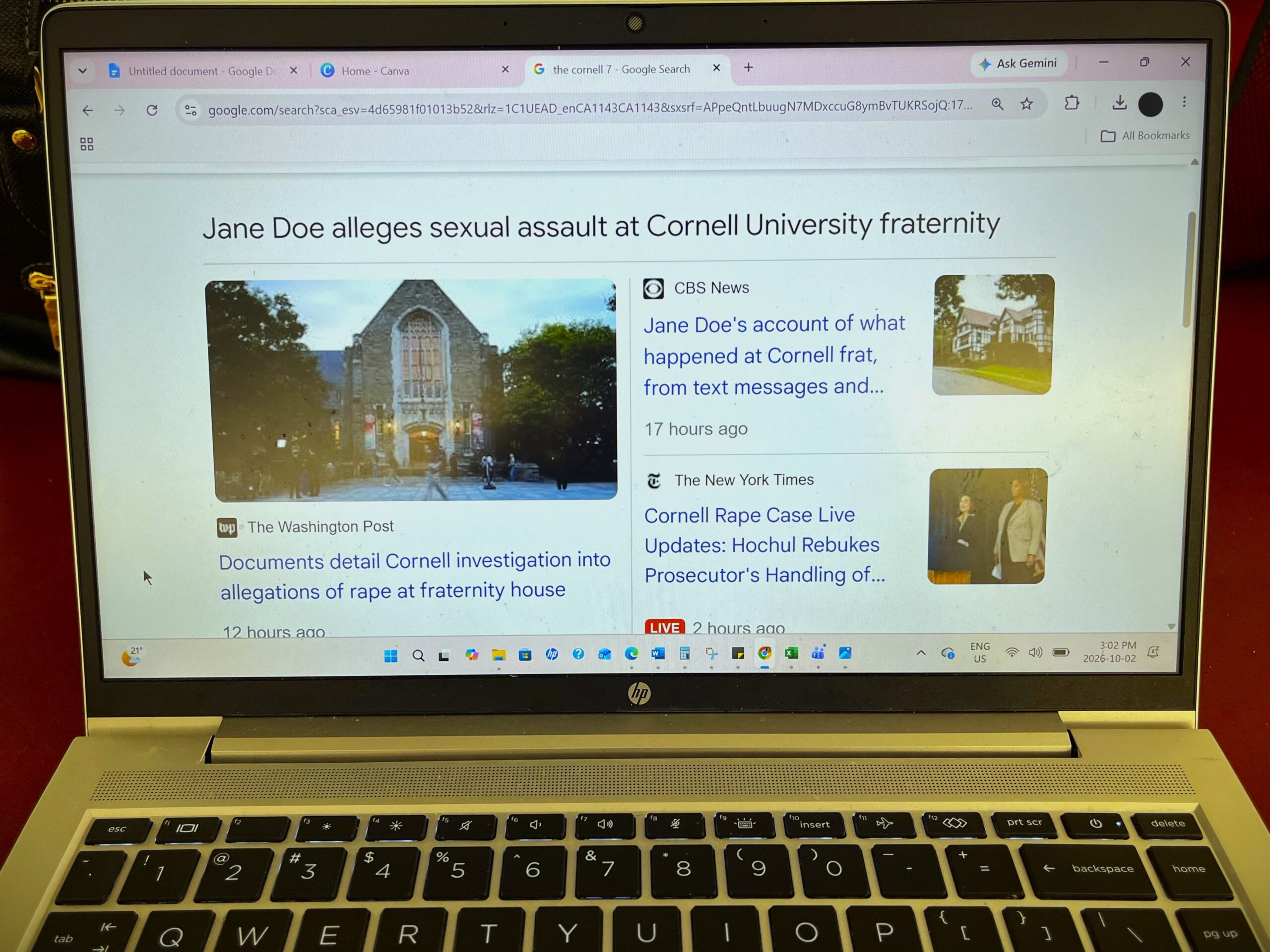
In recent weeks, the internet has exploded with conversation over an alleged gang rape that took place at Cornell University. From outrage to victim blaming, it seems that every TikTok user has commented on the alleged incident. Before we explore the discourse surrounding the incident, however, it is crucial to cover exactly how Jane Doe — the alleged victim of the gang rape, who has chosen to remain anonymous — has described the events that are said to have taken place at Cornell two years ago.
Following the timeline created by CBS News, here is how the events are said to have occurred:
On Oct. 19, 2024, Jane Doe had prepared for an average night out. She “drank vodka until she was intoxicated” at a sorority house and at 8:30 p.m., her and the sorority chapter’s “house mother” took an Uber to a bar.
Notably, Doe mentions that, at the bar, “she was served more alcohol despite being underage.”
At 11 p.m., Doe left to meet a friend at the Chi Phi fraternity house. While there, Doe says she was propositioned to have a “sexual encounter […] with two men she knew.” At the time, Doe says she consented to this encounter, saying she was “OK with” it.
Responding to her statement that she was “OK” with the first sexual encounter, Doe told an investigator the following:
“Yeah, [I was OK with it] as much as I can be because, again, I was super drunk when I got there. […] But I was pretty OK with all of this.”
However, since Doe had been intoxicated at the time of this proposition, she could not, under conventional legal standards, consent — though in the United States, state-specific laws vary. Unfortunately, New York State law brings a sort of exception to this rule, since “rape charges generally need to involve force or a clear refusal of sex, unless the victim is physically helpless due to being unconscious, or mentally incapacitated due to being drugged without their consent [italics added].” Some argue that requiring victims to have been drugged “without their consent” leads to a “voluntary intoxication loophole” wherein some lawmakers can argue that, even if a victim was incapacitated, they “voluntarily” consumed alcohol, eliding allegations of force.
Following the first sexual encounter, CBS says that things “quickly spiraled.”
At 1:42 a.m., a message was sent in a Chi Phi Snapchat group titled “Chi Phi activities,” where one of the men notified the others that he had a woman they could have “free” sex with. Another man later messaged the group chat to see if the “shop [was] still open,” garnering an affirmative response from the man who initially offered up the woman’s body to his fraternity brothers.
At this time, Doe said she was “completely incapacitated” after extensive ketamine use, as the fraternity brothers allegedly coerced her into taking excessive amounts of the drug. Doe recalls hiding from the men under the covers of the bed, and consuming more ketamine in a heartbreaking account of the evening:
“I had become extremely uncomfortable with how this night was turning out, so my thought was, if I do ketamine again, maybe I will pass out. My thought was that if I passed out and these men have sex with me, then they could have been charged with rape at this point,” said Doe.
She regained consciousness early the next day and began processing the night’s events, ultimately determining “with 100 per cent confidence, [she] was raped.”
Doe’s allegations regarding the night’s events are undoubtably soul crushing and traumatic. However, several smaller pieces of the story demonstrate that what is alleged to have happened to Doe is not a rare act of extreme sexual violence. Through every step along the way as the night progressed, a different aspect of rape culture created the conditions in which a gang rape could occur, demonstrating just how easy it is to become a victim of sexual violence within a culture that normalizes rape.
Early in the night, Doe recounts receiving alcohol at a bar despite being underage. Though we have no insight on the bar’s motives behind this decision, researchers have found that alcohol “can be a major contributing factor” to sexual violence among college-aged victims. It is important to note that, in the American context in which the case took place, college students are predominantly underage, given that the legal drinking age is 21 years old.
Underaged bar-goers being served alcohol is an overwhelmingly common occurrence. Even in Toronto, Post City found that four out of the six local bars they visited had served underaged customers.
Given the connection between alcohol consumption and sexual violence vulnerability, the overall lax approach to underage drinking in both the Canadian and American contexts is incredibly troubling.
Though Doe being served alcohol while underage is an indirect tie to her vulnerability to sexual violence, the occurrence has a clear connection to rape culture.
The most troubling indication of rape culture in the Cornell case, though, is the fact that it was not just Doe and the men in the room with her who knew about the alleged gang rape while it was happening.
In fact, it has been confirmed that there were over 50 men in the “Chi Phi activities” group chat, receiving the messages that the gang rape was occurring.
Though only seven men are alleged to have participated in the gang rape, roughly 50 others knew about it and did not care to alert authorities or confirm Doe’s safety. Each man who chose not to participate but read the messages may not be found guilty in a court of law, but they are the mechanisms through which rape culture gains power and stays intact.
Rape culture persists when you know your friend committed an act of sexual violence and you stay quiet or fail to label it “rape.”
Rape culture persists when masculinity is repeatedly tied to sexual aggression and prowess.
Rape culture persists when we consider violent pornography the norm, affirming the observations made by feminist writer and activist Catharine MacKinnon in her 1984 essay “Not a Moral Issue” that pornography is really just “sex forced on real women so that it can be sold at a profit to be forced on other real women; women’s bodies trussed and maimed and raped and made into things to be hurt and obtained and accessed and this presented as the nature of women; the coercion that is visible and the coercion that has become invisible.”
Rape culture persists when convicted — and unconvicted — abusers continue to occupy high positions in society. It also persists when survivors speak out against these abusers and, instead of receiving empathy, they are battered, blamed and discredited by the public.
All these seemingly small occurrences come together to make countless instances of sexual violence seem excusable, normal and justified. The alleged gang rape at Cornell is no different.
Right now, it is estimated by the World Health Organization that one in three women will experience intimate partner violence (IPV) or sexual violence in their lifetimes. Both IPV and sexual violence are absolutely harrowing things to experience; they often permanently alter your life, identity and view of the world, and access to supports does not nearly measure up to the number of survivors of this trauma, meaning that some get left behind.
Rape culture is not some abstract force we have no control over. It persists in our power structures and our social leadership, but also within the individual choices we make every day.
And it is never too late to change.
If you see questionable behaviour or beliefs from your friends, say something. Educate yourself on the intricacies of consent. Believe survivors when they become vulnerable with you and share their stories. Use your democratic power to vote for government officials who share your values.
You might just save someone’s life.