

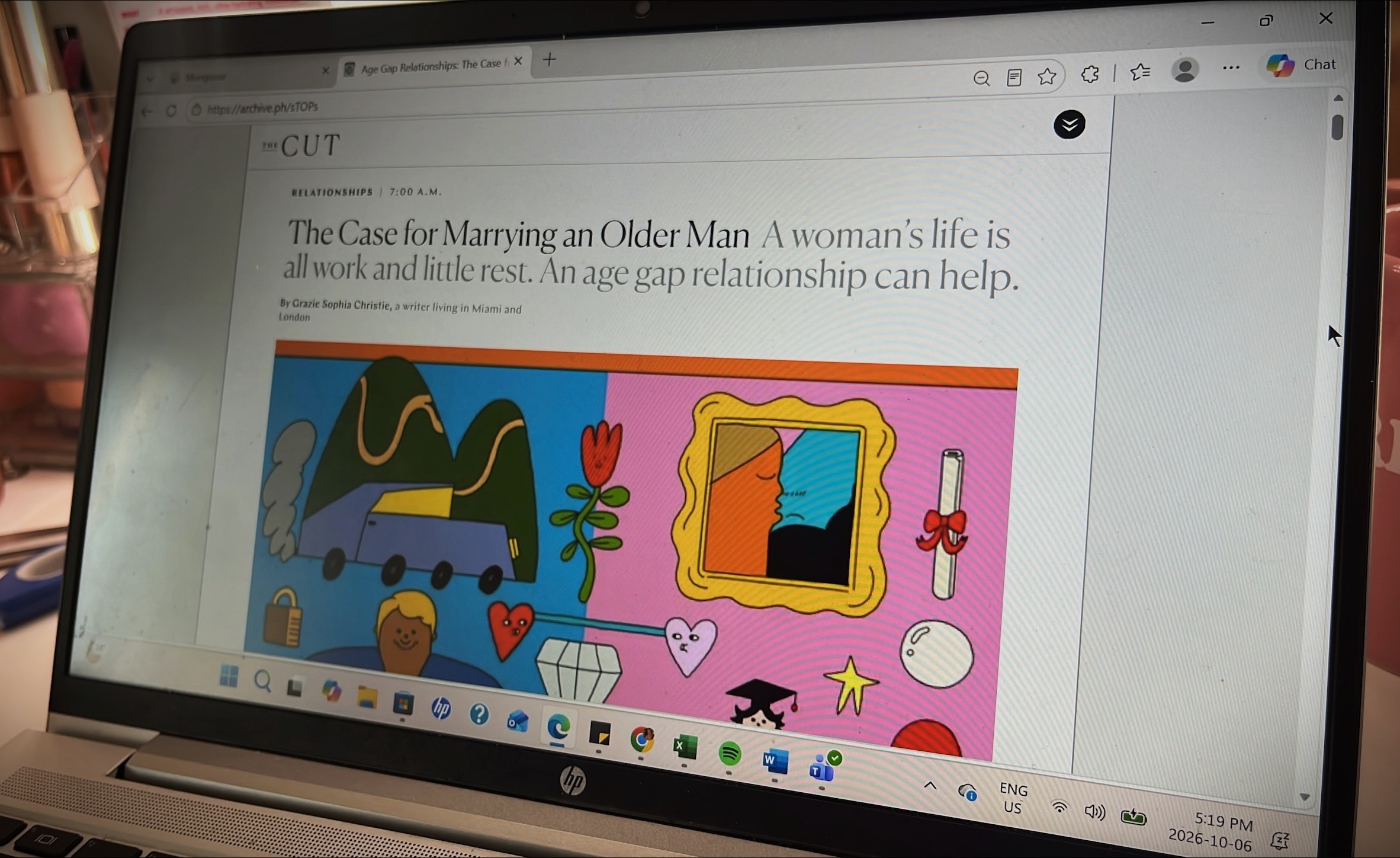
The Cut published a piece arguing that young women should take advantage of their beauty while it lasts and bag themselves a (rich) older man. Clearly, the piece presents quite a shallow perception of romantic relationships.
On March 27, 2024, The Cut writer Grazie Sophia Christie published a piece detailing her experience meeting her future husband through her endeavours dating older men at just 20 years old. In the piece, titled “The Case for Marrying an Older Man: A woman’s life is all work and little rest. An age gap relationship can help,” Christie draws upon a common experience in heterosexual dating: that women often must pseudo-parent their male partners into fully functioning adults. Though the piece is over two years old, it has come back into circulation following the publication of The Cut’s latest viral article alleging that Gen-Z women are financing their boyfriends’ lives — an article that, clearly, has not escaped the reductive gendered discourse Christie shares in her piece.
She tells stories of her friends who have had to teach their partner “how to floss,” properly pack their suitcases and overall exhibit a degree of emotional maturity. Admittedly, Christie illustrates this problem with a delicate and thoughtful pen:
“A million boys who know how to touch a woman, who go to therapy because they were pushed, who learned fidelity, boundaries, decency, manners, to use a top sheet and act humanely beneath it, to call their mothers, match colors, bring flowers to a funeral and inhale, exhale in the face of rage, because some girl, some girl we know, some girl they probably don’t speak to and will never, ever credit, took the time to teach him. All while she was working, raising herself, clawing up the cliff-face of adulthood. Hauling him at her own expense.”
Christie situates this issue within the title of “partnership.” She writes that young women are becoming “partners” to their significant others at increasing rates. Being “partners” does not mean operating from an equal playing field, according to Christie; “partnership” is glorified parenting.
From here, Christie begins to argue that ambitious young women need someone who can provide them stability as they go take on the world. I mean, how can they follow their dreams with some incompetent man weighing them down each step of the way, sucking the life out of them with financial and emotional neediness?
She tells another story of a friend and her “partner,” who were “ambitious, hyperclose and intertwined in each other’s projects.” She describes the “intense dedication” between them as they navigated adulthood together, always first to cheer each other on through each accomplishment. To me, this sounds like the ideal romance between two passionate people, but Christie disagrees, writing:
“I took calls from a dear friend who had a boyfriend her age. […] If each was a start-up, the other was the first hire, an intense dedication I found riveting. Yet every time she called me, I hung up with the distinct feeling that too much was happening at the same time: both learning to please a boss; to forge more adult relationships with their families; to pay bills and taxes and hang prints on the wall. Neither had any advice to give and certainly no stability. I pictured a three-legged race, two people tied together and hobbling towards every milestone.”
In short, Christie argues that the seemingly egalitarian nature of her friend’s relationship will likely be the very reason for its demise. Instead, Christie says, a young woman should find an older man to foot the bill for her passions, get her in touch with the professional networks he has already made in his career, and tell her how she should live her life.
To me, Christie’s ideal partner dynamic sounds a lot like a rich parent bringing a nepotism baby into the workforce.
The clearest red flag here is that Christie’s articulation of romance really just sounds like a business transaction. Even in describing her own relationship compared to her friend’s, her language sounds cold and devoid of the same intense passion she describes above.
“My husband isn’t my partner,” Christie writes. “He’s my mentor, my lover, and, only in certain contexts, my friend. I’ll never forget it, how he showed me around our first place like he was introducing me to myself: This is the wine you’ll drink, where you’ll keep your clothes, we vacation here, this is the other language we’ll speak, you’ll learn it, and I did.”
Interestingly though, in Christie’s description of her relationship, age doesn’t necessarily seem relevant. Though she troublingly notes that her partner is more of a mentor than a friend (which, to me, sounds like it situates him closer to a boss than a husband), the rest of the supposed endearing things about the early stages of their relationship don’t seem to have anything to do with age.
These things do, however, heavily involve class.
When you introduce your partner by first noting that he decides where you two “vacation” and what wine you drink, you’ve situated them within an upper-class archetype and identified yourself as aligned with that archetype by proxy.
So truly, the man in question isn’t so great because the years of wisdom he has over her made him an expert at knowing where to vacation and what wine to drink, his financial privilege did.
Christie’s commentary on how young women should approach relationships is incredibly misleading. The preference for dating older men has absolutely nothing to do with her argument in the piece. Ultimately, Christie isn’t exploring the question of having an age demographic preference in dating; she’s encouraging young women to seek their future husbands according to their class status.